Last updated 2026-08-21
TL;DR
A backflow tester field-tests backflow prevention assemblies so contaminated water cannot run backward into drinking lines. No federal tester license exists. You start with a course your state or water purveyor accepts, a written plus hands-on exam, a calibrated differential gauge, and a listing with the utility. Paper, recert windows, and fees are all local. Confirm every requirement with the board that will list you.
What is a backflow tester?
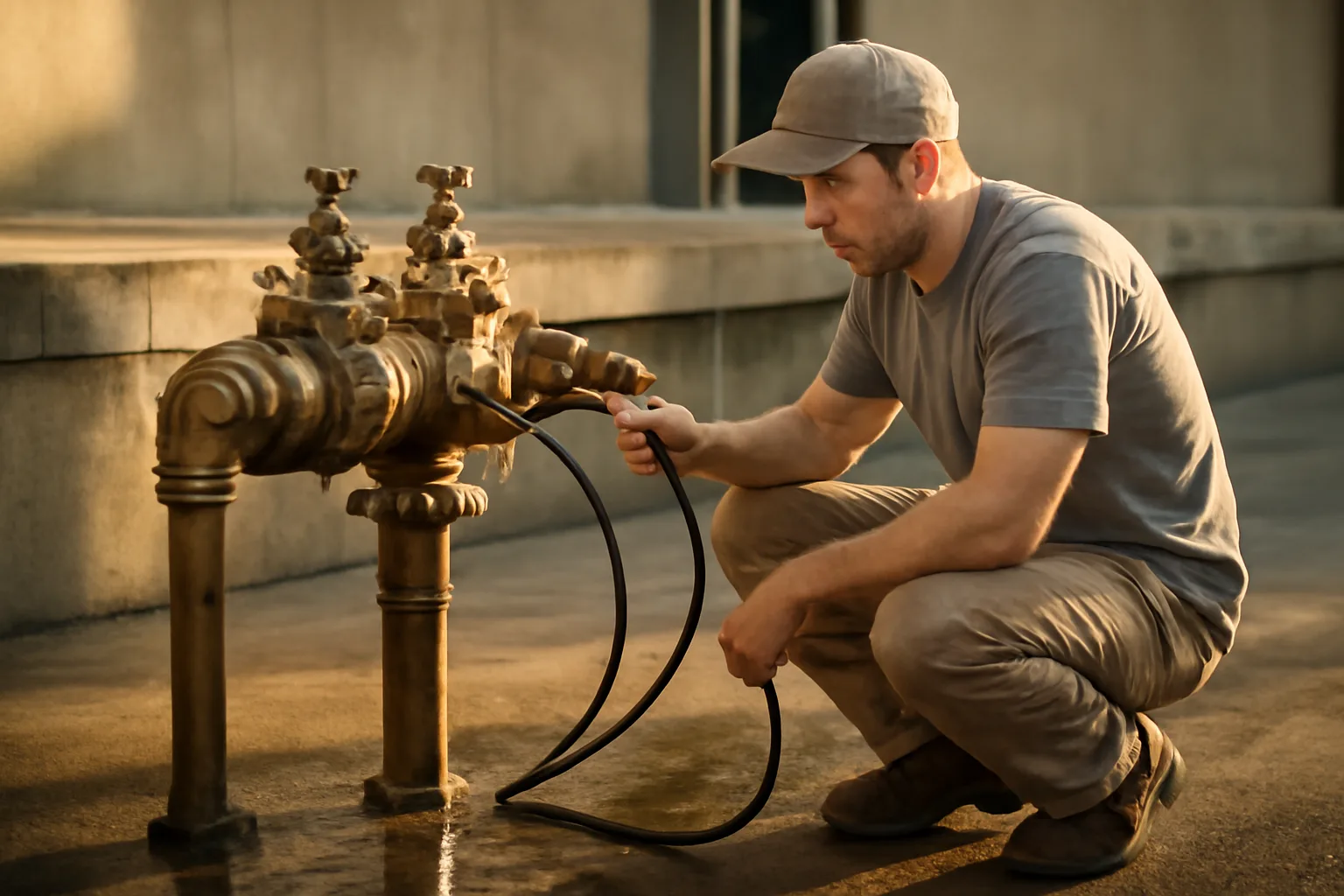
A backflow tester is a person a state, county, or public water system allows to field-test backflow prevention assemblies on drinking-water lines. You attach a calibrated differential pressure gauge, run the procedure for that assembly type, and file the result with the purveyor. That is the whole job.
There is no federal badge. The Safe Drinking Water Act makes EPA, states, and water systems responsible for safe water. It does not license testers. [7] EPA said this plainly in its Cross-Connection Control Manual: "There are presently no federal regulations covering cross-connection control." [1] States fill the gap with drinking-water rules, plumbing codes, and utility ordinances.
Backflow is water moving the wrong way. A cross-connection is the joint where nonpotable liquid, gas, or used water can meet potable piping. EPA's manual frames the hazard in those terms and hands program design to the water systems. [1] Testers sit at the bottom of that stack. You do not write the ordinance. You generate the test data the ordinance requires.
I treat the title as a listing, not a personality. If the water district will not put you on the tester list, customers cannot use your reports. Skill without listing is a hobby.
Some testers only test. Some also repair. Some hold a specialist credential that surveys hazards for the utility. Those are different cards. Read yours. If it says tester, you test. Turn wrenches past the test cocks and you may have left the tester scope and entered plumbing or repair work the same board regulates separately.
How do you start as a backflow tester?
You start by naming the agency that will actually accept your reports, taking only the course that agency wrote down, passing its written and practical exams, then showing a calibrated gauge and the ID it asked for. There is no single national on-ramp. Confirm the current application with that board before you pay anyone.
Do this in order. Reversing it wastes money.
First, list the water systems you want to file with. Read their tester packet. Ask which credentials they accept this year. Some take an ASSE 5110-style tester card. Some take a state occupational license. Some only take their own class. California water suppliers still run local listing even after you sit a section exam. [5] [13] Texas runs a TCEQ Backflow Prevention Assembly Tester license as a state occupational credential. [9] Washington uses a BAT certificate inside waterworks rules, and the purveyor's program still has to meet WAC 246-290-490. [2]
Second, sit the course those agencies named. Expect classroom time plus a wet lab on RP, DC, and PVB assemblies. Online-only theory with no hands-on bench is a waste if your board requires a practical. I would not buy a seat until I had the acceptance list in writing.
Third, pass both exams. Apply to be listed. Get the gauge certified to the accuracy the procedure demands, through a lab the board recognizes. Then run a couple of low-stakes tests if the purveyor allows it. The first real RP in a flooded vault is a poor classroom.
Paper after that is local. Forms, tags, recert clocks, and repair limits all come from the same packet. If you plan to work across state lines, read backflow tester renewal in california and backflow tester renewal in florida to see how fast the paperwork splits.
Is there a national backflow tester license?
No. There is no U.S. federal backflow tester license. EPA does not issue tester cards. [1] [7] [8]
People sell "national" as if ASSE, ABPA, or a USC course were a passport. Those are training and professional qualifications. A water purveyor may accept them. Or it may ignore them and demand its own exam. Florida community water systems must run a cross-connection program under Rule 62-555.360, F.A.C. That rule talks to the water system, not to a national tester guild. [3]
New York's sanitary code puts control of cross-connections on the water supplier. [4] California Title 17 puts testing duties on the water supplier and the customer-user, with testers working inside that structure. [5] Same pattern each place. The legal hook is the water system. You hang off that hook.
Federal drinking-water standards live in 40 CFR Part 141. They still do not create a tester license. [8] If someone quotes a national registry as enough to work in a city you have never contacted, walk away. Spend the phone call, not the registry fee.
What certification does a backflow tester need?
You need the certification named in the tester packet of the water system, or state board, that will accept your reports. That is the only certification that counts on day one.
ASSE 5110 is the common professional-qualification standard for testers. USC's Foundation for Cross-Connection Control and Hydraulic Research publishes the Approved List of assemblies many agencies treat as the reference catalog. [10] Neither one is, by itself, a license to file in a city that did not opt in.
Texas is the clean counterexample. TCEQ licenses Backflow Prevention Assembly Testers as an occupational license. You deal with TCEQ, then with the purveyor. [6] [9] Washington BATs sit inside WAC waterworks certification, and WAC 246-290-490 still requires the purveyor to use a written program and proper testing. [2]
I would collect three documents before I paid tuition. The statute or rule. The purveyor's current tester application. The recert clock. If those three do not name the school you like, pick another school.
Massachusetts drinking-water regulations at 310 CMR 22 address cross connections at the water-system level. [11] Wisconsin plumbing code SPS 382 covers backflow prevention devices in the plumbing layer. [12] Two different doors. Testers get tripped when they train for the wrong one.
| Place | Who actually lists you | Legal hook to confirm | Notes |
|---|---|---|---|
| Washington | BAT plus each purveyor | WAC 246-290-490 | Written CCC program is on the utility [2] |
| Texas | TCEQ BPAT, then the purveyor | 30 TAC 290.44 and TCEQ licensing | State occupational license [6] [9] |
| California | Local water supplier | 17 CCR 7605 and HSC 116800 | Title 17 testing sits on the supplier [5] [13] |
| Florida | Utility program plus local practice | Rule 62-555.360, F.A.C. | Rule is aimed at the water system [3] |
Nobody has a clean national dataset of which card each district scans this month. The closest honest method is still the packet in front of you.
Do you need a plumbing license to test backflow?
Sometimes. Many jurisdictions let a non-plumber test if the tester credential is in order. Others fold testing into the plumbing license, or require you to work under a plumbing contractor once a repair starts.
I would not assume plumber status. I also would not assume you can skip it. Florida practice in a lot of counties still expects a plumbing license in the mix for work beyond a test. Confirm with the drinking-water board and the local plumbing official, because those two offices disagree more often than course catalogs admit.
Repairs are the trap. A tester card often lets you test only. Swapping a relief valve or rebuilding a check can be plumbing work. Turn a wrench past the test cocks and you may have left the tester scope.
Texas BPAT is a testing license through TCEQ. [9] It is not automatically a plumbing contractor license. Keep the scopes separate on your invoices. Wisconsin SPS 382 is a plumbing code, not a tester diploma. [12] Do not confuse a device standard with a personal credential.
What paper does a first-year backflow tester file?
You file whatever form the water purveyor printed, on the schedule that purveyor set, with the gauge serial number and your credential number in the boxes they designed. First-year work is almost entirely paper plus gauge.
Typical packet, in plain terms. Initial listing application and copies of your course card. Gauge calibration certificate, dated inside the window they name. A test report for each assembly, often due within a small number of days after the test. Failed-test notices, because a failed RP is a public-health problem, not a private hint. A recertification reminder to yourself, because the board will not babysit you.
California suppliers notify customer-users that periodic testing of backflow preventers is required under Title 17. Your report is how that duty gets met. [5] Washington purveyors must have a written cross-connection control program and use proper inspection and testing. [2] You are filling their program, not running your own. New York puts the same class of duty on the supplier under 10 NYCRR 5-1.31. [4]
If you want a paper checklist aligned to ASSE 5110/5115 tester tasks, ASSEPath sells a $149 one-time Tester Kit. It does not replace the form your water district requires, and it is not a credential.
Keep a copy of every report for the period the purveyor names, plus a year. Drive and paper. People lose arguments when they cannot produce the same PDF they swore they uploaded.
For state-by-state renewal paper after you are listed, see backflow tester renewal in arizona and backflow tester renewal in colorado.
What gauge and tools does a backflow tester need?
You need a differential pressure test kit the procedure recognizes, fittings that match the test cocks you will see, and a calibration certificate the listing agency will accept. Fancy extras are optional. The gauge is not.
Most field procedures track the USC and AWWA differential-kit method for RP and DC tests. Accuracy and calibration interval are set locally. A lot of programs want annual calibration by a lab they recognize. Confirm that. Do not guess from a forum.
Buy a used kit only if you can send it straight to calibration and get a pass. A cheap uncalibrated gauge is how you get delisted. Test cocks on old assemblies will be ugly. Carry adapters. Carry a spare hose. Do not carry a gadget your course never used, because your practical exam and your field method should match.
USC's Approved List tells you which assemblies the Foundation has evaluated. [10] It does not tell you which hose color your instructor wants. Learn the method your listing agency still uses.
Vaults collect water, insects, and bad air. You can get hurt in a meter pit on a routine test. Treat vault work as serious and skip jobs you are not set up for.
How often must backflow assemblies be tested?
Most drinking-water programs want assemblies tested on install, after repair or relocation, and at least once a year. Washington's WAC 246-290-490 requires the purveyor to develop and implement a written cross-connection control program, and it puts inspection and testing of backflow preventers on a cycle of that kind. [2] California Title 17 also builds periodic testing into the supplier's program. [5]
Annual is the default to plan your calendar around. Some hazards get tighter intervals because the purveyor said so. Some irrigation PVBs get tested by season. None of that is a federal EPA test clock. EPA told states there are presently no federal cross-connection regulations, then pointed them at SDWA duties. [1] [7] States and suppliers set the dates.
Failed tests need a retest after repair. Do not leave a failed RP until next year. That is how people get people sick, and how testers lose listing.
Florida Rule 62-555.360 requires community water systems to establish and implement a cross-connection control program. [3] The due dates live in that program, not in a national brochure. Ask for the written program. New York's 10 NYCRR 5-1.31 makes the same kind of assignment to the supplier. [4]
How much does it cost to become a backflow tester?
I will not quote a fake average fee, because boards change fees and schools change tuition. Confirm every dollar with the agency that lists you and with the school that agency accepts.
The spend that actually happens, in buckets. Course and exam, the line that varies most. State occupational exams (Texas TCEQ is the clear case) have posted license information on the agency site. [9] Private courses invoice you separately. Gauge and fittings: new professional differential kits cost real money. Price current kits from the manufacturers your course uses, then add calibration. I would not buy a kit from a random marketplace seller without a calibration path. Listing and recert: some water districts charge nothing to be on the list. Some charge. Some make you sit their exam even after you paid a private school. Insurance and business registration if you go independent. That is a business cost, not tester mysticism.
Waste of money, in my view. Paying twice for overlapping national cards before you know which card the district scans. Truck wraps in week one. Same-week branding packages. Get listed, file ten clean reports, then decide if you even like vaults.
Processing time is not something I will guarantee. Boards move at board speed. Anyone selling a fixed approval clock is selling you a story.
What is the difference between a tester and a repairer?
A tester field-tests assemblies and files reports. A repairer rebuilds or repairs those assemblies. A Cross-Connection Control Specialist, or the local equivalent, surveys hazards and sets the protection scheme for a water purveyor.
Do not mix them on a business card as if they were one badge. Washington's framework puts program duties on the purveyor and testing on qualified testers. [2] A specialist working for the utility may review your test. That person is not you.
ASSE 5110-style tester qualifications and 5115-style repair qualifications exist for a reason. A lot of boards still split them. If a customer asks you to just work out what a hospital needs, that is specialist or professional-engineer territory in many programs. I would test the assembly they already have, or decline.
Texas distribution rules in 30 TAC 290.44 still sit on the public water system. [6] Your repair invoice does not rewrite that. Keep tester work, repair work, and design work on separate paper.
How does backflow tester recertification work?
Recertification is a local clock. Common patterns are one, two, or three years, with a written exam, a practical, or both, plus proof of tests completed. Confirm with the board. I will not invent your due date.
Some states attach tester recert to the occupational license. Texas TCEQ is that model. [9] Some attach it to a BAT or county card. Some water districts demand their own refresher even if your state card is current. California listing practice is a good example of local overlays. Check backflow tester renewal in california rather than trusting a national brochure.
Alaska and Alabama are not the same packet either. If you move, start over with the new board. See backflow tester renewal in alaska and backflow tester renewal in alabama.
Miss the window and you are unlisted. Unlisted means your reports bounce. There is no grace period I would bet a customer relationship on. Georgia testers learn the same lesson when they import another state's habits. Read backflow tester renewal in georgia before you assume the last card still works.
Which first-year backflow tester mistakes waste money?
Paying for a course the local list will not accept. That is the expensive one.
Testing with an out-of-date gauge. Filing the wrong form, or the right form to the wrong inbox. Repairing when your card is tester-only. Promising a hospital you can certify the whole building when you can only test the assemblies they point at.
Purveyors check that you hold the credential they named, that your gauge calibration is in date, and that they can reach you when a test is late. WAC 246-290-490 requires the purveyor to run a written program. [2] Florida Rule 62-555.360 requires community systems to establish and implement a cross-connection control program. [3] Listing you is how they staff that duty. They are not doing you a favor. They are reducing their own risk.
Bring originals. PDFs of faded cards cause delays. If they ask for a local business license, that is their packet, not a scam by default. Confirm it on their letterhead.
Skip any vendor who says approval is guaranteed or that processing takes a fixed number of days. Boards change. ASSEPath is an independent publisher, not a law firm and not a service company. If you want the kit path, use /start. Then still call the board.
Frequently asked questions
What is a backflow tester?
A backflow tester is the person a state or water purveyor lists to field-test backflow prevention assemblies and file the official report. You run a differential pressure procedure on devices such as RPs and DCs. There is no federal tester license. The water system's program, under state drinking-water rules, is what makes your signature count. Confirm listing rules with that system.
How do you start as a backflow tester?
Find the agency that will list your reports. Take only the course that agency accepts. Pass the written and practical exams. Submit your card, ID, and gauge calibration. Then file tests on that system's form. Do not pay for a second national card until you know the first one is accepted. Confirm fees and current forms with the board. Nothing about timing is guaranteed.
Can you test backflow without a plumbing license?
In some places yes, if the tester credential and listing are in order. In others the plumbing license is required, especially once a repair starts. Tester scope and plumbing scope split more often than course ads admit. Confirm with the drinking-water board and the local plumbing official. Do not assume either answer from a national brochure.
Does ASSE 5110 work in every state?
No. ASSE 5110 is a professional-qualification standard many schools teach to. A water purveyor or state board may accept it, require extra local listing, or ignore it. Texas uses a TCEQ occupational license. California suppliers still run their own lists under Title 17. Ask the agency that will file your reports before you pay tuition.
Who accepts USC tester training?
Agencies that wrote USC methods into their packet. USC's Foundation publishes the Approved List of assemblies many programs use as the catalog. That list is not a personal license. Some utilities want USC-style procedures and still demand their own tester card. Confirm with the purveyor. Do not treat a course logo as a filing right.
How often do you calibrate a backflow test gauge?
Most listing agencies want the differential pressure kit calibrated on a short local clock, often annually, by a lab they recognize. That interval is not set by EPA. It is set by the board that lists you. An out-of-date sticker is a common reason reports bounce. Confirm the current window and the accepted labs before you test.
Can you test your own backflow assemblies?
Some utilities forbid owner-occupied testing because it is a conflict. Others allow it if you are listed. Health-care, industrial, and high-hazard sites are where programs get strict. Read the purveyor's written cross-connection program. If the packet is silent, ask in writing. I would not test my own RP and then argue about it later.
Do independent backflow testers need insurance?
Often yes, as a business matter and sometimes as a listing condition. General liability is the usual ask. The water district may also want you to hold a local business license. Those are not tester-exam topics. They still stop listing. Confirm the current packet. I would not start field work with a card and no coverage.
Are online-only backflow tester courses enough?
Only if the listing agency said a practical exam is not required, which is uncommon. Most boards still want hands-on work on RP, DC, and PVB assemblies. A theory course with no wet lab is a poor fit for those packets. Get the acceptance list in writing, then buy the course that matches it. Skip the rest.
How do you get on a water district tester list?
Submit the credential they named, current gauge calibration, ID, and their application. Some also give a short local exam. Washington, Florida, California, and Texas all hang listing off the water system's program duties, not off a federal card. Bring originals. Confirm fees with that district. Listing is not automatic after a private school diploma.
What goes on a backflow test report?
Assembly location, make, model, size, serial, your credential number, gauge serial, readings for that procedure, pass or fail, and the date. The purveyor designed the boxes. Use that form. Failed RPs need prompt notice, not a private sidebar. Keep a copy for the retention period they name. Wrong email, wrong form, late file. Those are the usual rejects.
Is a backflow tester the same as a CCS?
No. A tester field-tests assemblies. A Cross-Connection Control Specialist, or the local equivalent, surveys hazards and sets protection for the water purveyor. Repairer credentials are a third path. Mixing the titles on a card is how people bid work they cannot legally sign. Read the card the board printed, not the slogan on the truck.
Sources
- U.S. EPA, Cross-Connection Control Manual (EPA 816-R-03-002): EPA states there are presently no federal regulations covering cross-connection control; the 2003 manual remains federal guidance for programs run by states and public water systems.
- Washington State Legislature, WAC 246-290-490 Cross-connection control: Washington purveyors must develop and implement a written cross-connection control program, including inspection and testing of backflow preventers on a cycle that includes at least annual testing.
- Florida Department of State, Rule 62-555.360 F.A.C. Cross-Connection Control for Public Water Systems: Florida community water systems must establish and implement a cross-connection control program under Rule 62-555.360.
- New York State Department of Health, 10 NYCRR 5-1.31 Control and elimination of cross connections: New York's sanitary code assigns control and elimination of cross-connections to the water supplier.
- Cornell LII, California 17 CCR 7605 Testing: California Title 17 requires periodic testing of backflow preventers inside the water supplier's program.
- Texas Secretary of State, 30 TAC 290.44 Water Distribution: Texas drinking-water distribution rules in 30 TAC 290.44 include backflow and siphonage controls on public water systems.
- Cornell LII, 42 U.S.C. § 300f (Safe Drinking Water Act definitions): The Safe Drinking Water Act, at 42 U.S.C. § 300f et seq., is the federal drinking-water statute; it does not create a national backflow tester license.
- eCFR, 40 CFR Part 141 National Primary Drinking Water Regulations: Federal National Primary Drinking Water Regulations are codified in 40 CFR Part 141 and still do not license backflow testers.
- USC Foundation for Cross-Connection Control and Hydraulic Research, Approved List: USC FCCCHR publishes the Approved List of backflow prevention assemblies used as a reference catalog by many water agencies.
- Massachusetts Mass.gov, 310 CMR 22.00 Drinking Water regulations: Massachusetts drinking-water regulations at 310 CMR 22 address cross-connection control at the public water system level.
- Wisconsin Legislature, SPS 382 plumbing code: Wisconsin SPS 382 sets plumbing-code requirements for backflow prevention devices, a separate door from personal tester listing.
- California Legislative Information, Health and Safety Code § 116800: California Health and Safety Code section 116800 is part of the state's statutory hook for cross-connection control by water users.