Last updated 2026-08-21
TL;DR
A backflow tester field-tests assemblies that stop contaminated water from reversing into potable lines. There is no federal tester license. Start by confirming who accepts testers in your water system, finish an approved course (ASSE 5110, ABPA, USC, or state), pass written and practical exams, certify your gauge, then file locally. Confirm fees and forms with that board.
What is a backflow tester?
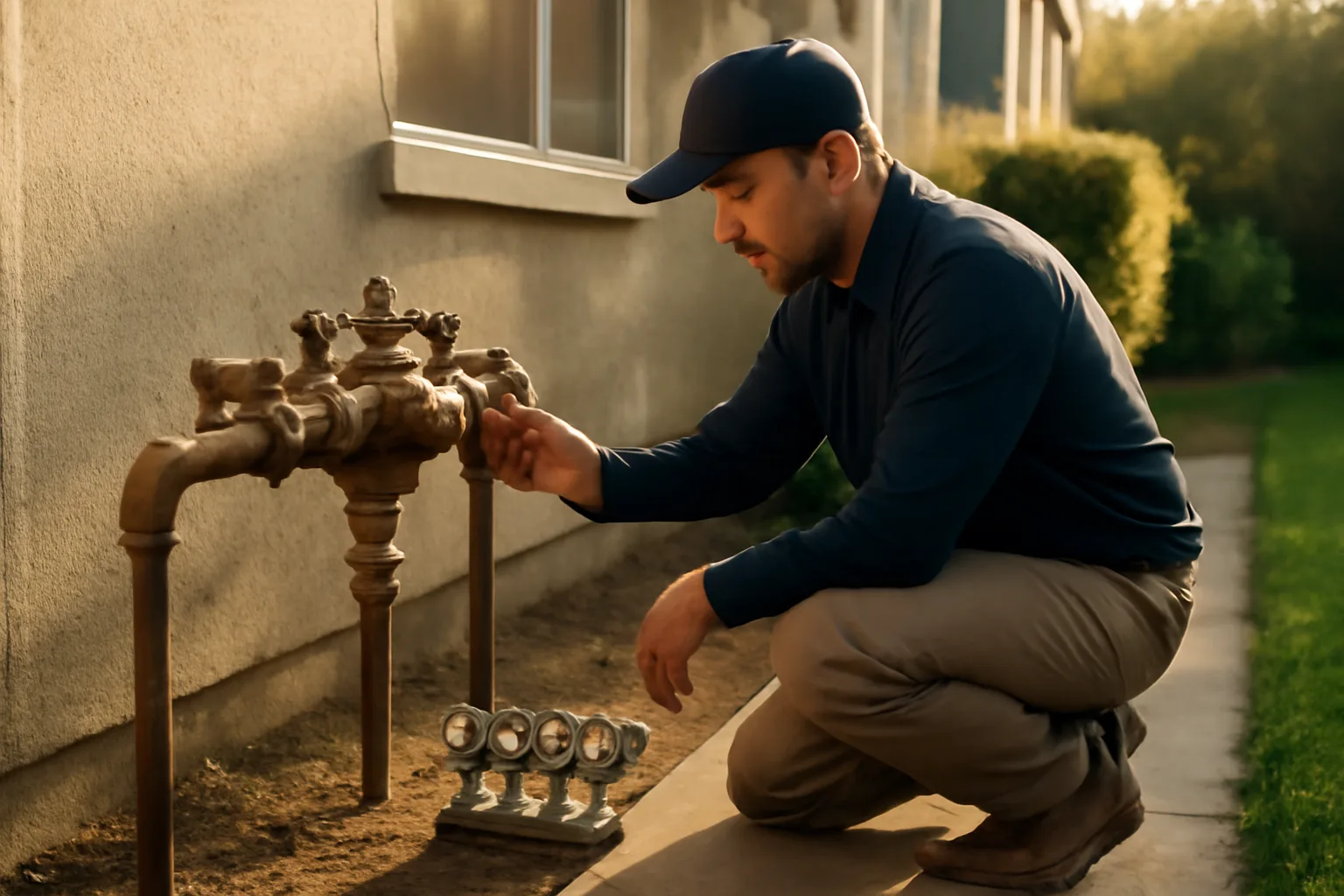
A backflow tester is the person a water supplier or health agency accepts to field-test mechanical backflow prevention assemblies on potable water lines. The work is differential-pressure testing, a pass or fail call, and a report the purveyor keeps on file. It is not system design. It is not a federal occupation.
Backflow is the reverse flow of water (or a mix of water and other stuff) into the potable supply. EPA’s Cross-Connection Control Manual states it this way: “Backflow is the undesirable reversal of flow of water or mixtures of water and other liquids, gases, or other substances into the distribution pipes of the potable supply of water from any source or sources.” [2]
A cross-connection is the physical point where that can happen. An irrigation main. A fire sprinkler riser. A boiler feed. A mop sink with a hose dropped in it. The tester’s job is to prove the assembly at that point still holds.
You show up with a differential-pressure gauge, hook the hoses in a set order, record relief-valve opening, check-valve tightness, and shutoff behavior, then leave a tagged result. Failures get repaired by someone the local rules allow to repair. In many towns that person carries a different credential (often ASSE 5115), not the tester card.
If you like mechanical work, outdoor sites, and paper a water department can audit, this trade fits. If you want a single national badge that opens every city, stop looking. That badge does not exist.
Is there a national backflow tester license?
No. The Safe Drinking Water Act became law in 1974 and still does not create a federal backflow tester license. [1] EPA tells public water systems to keep drinking water safe. States and local purveyors write the tester rules.
People sell “national cert” as if it were a passport. It is not. ASSE 5110, ABPA tester credentials, and the USC Foundation tester course are training standards a lot of systems recognize. Water systems still decide whom they put on their tester list. Some states add their own occupational license on top of that.
EPA published the Cross-Connection Control Manual (EPA 816-R-03-002) in February 2003 as technical guidance, not as a tester licensing code. [2] The 1986 and 1996 SDWA amendments did not create a tester license either. [1]
So the real map is local. California leans on Title 17 and the water supplier. [6] Texas runs a TCEQ Backflow Prevention Assembly Tester license. [5] Washington certifies Backflow Assembly Testers under WAC 246-292 and makes systems run a cross-connection program under WAC 246-290-490. [3] [4] Florida community water systems must run a cross-connection program under FAC 62-555.360, then counties stack their own tester lists on top. [7]
Any website that promises “licensed in all 50 states this weekend” is selling marketing. I would not pay for it.
How do you start as a backflow tester?
You start by naming the authority that will actually accept your test reports. Then you take the course that authority names. Then you file. That is the whole path. Skip the national myth and work backward from the water purveyor or state board.
First, call the cross-connection specialist at the water system where you want to work. Ask who they list, which credentials they take, which gauge brands they reject, and which report form they want. Get the answer in writing if you can. Rules differ between two towns that share a county line.
Second, enroll in the matching course. That may be ASSE 5110, an ABPA tester course, a USC Foundation tester course, or a state-approved class such as Texas TCEQ’s BPAT training. [5] [10] Bring the ability to read a gauge and sit through wet labs. Most serious courses mix classroom theory with hands-on tests on RP, DC, PVB, and SVB assemblies.
Third, pass the written exam and the practical. Fail the practical and you are not a tester, period. Fourth, get your gauge certified by a lab the course and the purveyor both accept. Fifth, submit the local application, insurance proof if they ask for it, and your card copies. Confirm every fee with that board the week you file. Nobody here can quote a current board fee without lying to you.
Aiming at a specific state? Use a state guide instead of this overview. Start with how to start as a backflow tester in California or how to start as a backflow tester in Alabama and work from the board’s forms, not from a forum thread.
What credentials do water systems actually accept?
Water systems accept whatever their state rule and their own ordinance name. In practice you will hear four families: ASSE Series 5110 tester qualification, ABPA tester certification, USC Foundation tester certification, and a state occupational license. Texas BPAT is the clean example of that last one. [5] [10]
ASSE 5110 is a professional qualification standard for testers. It is not a government license. ABPA is a membership association that runs its own tester certification. USC’s Foundation for Cross-Connection Control and Hydraulic Research wrote the field methods a lot of courses still teach. None of those three replace a state license where the state requires one.
Washington is a state-certificate model. WAC 246-292-0600 sets Backflow Assembly Tester certification requirements, and the water system still runs the program under WAC 246-290-490. [3] [4] California Title 17 puts competency in front of the water supplier or health agency. [6] New York puts the duty on the supplier of water under 10 NYCRR 5-1.31. [8] Oregon writes tester duties into OAR 333-061-0070. [9] Massachusetts does it in 310 CMR 22.22. [11]
Hold two credentials only if two lists you care about demand two logos. I would not collect cards for sport. Recertification clocks stack, and lapsed paper gets you dropped from the only list that pays you.
For the California packet, read backflow tester license in California next. For a license-heavy contrast, read backflow tester license in Alabama.
Do you need a plumbing license to test backflow?
Sometimes yes, often no. The only honest answer is the local plumbing law plus the water purveyor’s tester list. Testing is a diagnostic act. Repairing an assembly is usually plumbing or a separate repairer credential. Do not mix those two in your head.
Some cities let a certified tester who is not a plumber submit test reports, then require a licensed plumber (or an ASSE 5115 repairer) to rebuild a failed RP. Other cities fold testing into a plumbing contractor license and will not look at your ASSE card alone. Fire-line work can add a fire-protection contractor overlay.
I would ask three offices the same week: the water purveyor, the building or plumbing board, and (if fire assemblies are in play) the fire marshal. Write down the names of the people who answered. When those three disagree, the water purveyor still owns whether they accept your report for their cross-connection file.
Do not take a plumber’s exam just to feel official if your target districts list testers with no plumbing card. That exam is expensive and slow. Do take it if you also want to replace relief valves and check kits. Testing income and repair income are different businesses.
What assemblies does a backflow tester test?
The core set is four: reduced-pressure principle assemblies (RP or RPZ), double check valve assemblies (DC), pressure vacuum breakers (PVB), and spill-resistant vacuum breakers (SVB). Some courses add air-gap inspection and a look at dual-check devices, which you usually do not field-test the same way.
RPs protect against high-hazard cross-connections. They have two independent check valves and a relief valve that dumps to atmosphere if the zone between the checks is not right. DCs are two checks without that relief valve and get used on lower-hazard lines where the local rule allows them. PVBs and SVBs sit on irrigation and similar branches and need a different hose setup.
Your course should make you test each type wet, more than watch a video. If a weekend class never opens a relief valve, pick a different school. The EPA manual is built around preventing backsiphonage and backpressure at those assemblies, not around a personality certificate. [2]
Fire-protection DCs and RPs follow the same hydraulics and often a stricter owner (the fire department plus the water department). Ask before you quote a fire account. Some tester lists split domestic and fire.
How long is tester training and what does the exam look like?
Plan on a multi-day course with a written test and a timed practical on real assemblies. Exact hours belong to the provider and the board that approves that provider. I will not invent a national hour count. Texas points you at a TCEQ-approved BPAT course rather than a random online quiz. [5] Washington points you at BAT certification under WAC 246-292-0600. [4]
The written exam covers hydraulics, hazard levels, assembly identification, and the test sequence. The practical is the filter. You will set up a five-valve gauge, find a leaking number 1 check, and watch a relief valve open at the wrong differential if you hook your hoses backward. Instructors fail people. That is the point.
Online-only theory is a weak start. Use it to prep vocabulary if you want. Do not expect a water department to list you on a video certificate if their ordinance says hands-on. Confirm the exam format with the school and with the board on the same day. If they tell two different stories, believe the board.
I would take the first course near the districts you will actually drive to. Traveling for a prestige logo is a waste if your home purveyor only wants the state card.
What paper and tools do you need in year one?
You need a credential the local list accepts, a differential-pressure gauge with current certification, the purveyor’s report form (or their electronic portal login), and whatever insurance affidavit they print on the application. You also need a way to keep copies. Water systems audit testers. Lost reports become your problem.
Buy the gauge after you know which brands the course and the districts accept. A used five-valve kit from a retiring tester is fine if it passes the lab. A cheap no-name gauge that no calibration shop will touch is a waste of money. Extra hose colors and a shade tent help. A vinyl banner with your name on it does not.
Paper in year one is boring and it is the job. Installation tests, annual tests, after-repair tests. Photos of the assembly, serial numbers, meter numbers, GPS if the district wants it. Florida’s FAC 62-555.360 puts the cross-connection program on the community water system, which means your report is their compliance file, not a souvenir. [7]
Want a single checklist for ASSE 5110 and 5115 paper? ASSEPath sells a $149 one-time ASSE 5110/5115 Tester Kit. You can follow every step in this article without it.
For a cold-climate start path with different field constraints, see how to start as a backflow tester in Alaska. For desert-district practice, see how to start as a backflow tester in Arizona.
How do gauge calibration and recertification work?
Your gauge needs periodic certification by a lab the course and the water system both trust. Annual is common in tester culture. Do not treat that as a law of physics. Read the rule that governs your card and the tester agreement you signed with the purveyor.
Recertification of you (the person) is a separate clock. Some credentials run three years, some shorter, some want CE hours plus a practical. Washington’s BAT certificate is a state credential with its own renewal machinery under the WAC 246-292 series. [4] Association cards expire even if your state license does not, and the reverse is also true.
I keep a single spreadsheet with three dates: gauge lab due, tester card due, insurance due. Miss the gauge date and your otherwise valid tests can get rejected. Miss the card date and you vanish from the list during irrigation season, which is when the phone actually rings.
Do not pay for recert a year early unless the board’s form forces it. Do not skip it because work is slow. Reinstatement after a lapse is uglier than a timely class.
How much does it cost to get started?
I will not invent a national starter budget. Course tuition, exam fees, state license fees, gauge cost, lab certification, insurance, and the water-system listing fee all move, and they move by county. Confirm each line with the school and the board the week you write the check.
The expensive mistakes are predictable. Buying a gauge before class. Paying a middleman for a “nationwide license.” Sitting a plumbing contractor exam you do not need. Driving 400 miles for a logo your home district ignores. Skipping insurance when the listing form requires it, then rushing a binder at the deadline.
Cheap mistakes hurt too. The lowest-price weekend course with no wet lab. A gauge no local lab will certify. No copies of your test reports. Those cost you the accounts, which is worse than the cash.
State occupational fees belong on the board’s fee page, not on a blog. For a license-shaped example, use backflow tester license in Alaska and then open the agency PDF it points to. For a board-heavy western example, use backflow tester license in Colorado the same way.
What reports do testers file with water purveyors?
You file the form that system printed, on the schedule that system named, for the assemblies they track. Annual testing of assemblies is the normal rhythm in state cross-connection rules and in EPA’s guidance posture, with extra tests on install and after repair. [2] [3] Confirm the interval. Do not assume every device in a mechanical room runs on a one-year clock.
A useful report has site address, location of the assembly, make, model, size, serial number, line pressure, the recorded differentials, pass or fail, tester name, credential number, gauge serial, gauge cert date, and signature. If the portal wants a photo of the data plate, take the photo.
Failing an assembly is not optional politeness. If the relief valve opens early or a check leaks, you mark fail and you notify the process the district wrote. Repair, then retest. Title 17 in California puts testing competence and due dates in the supplier’s world. You are feeding that machine. [6]
Electronic portals reject late filings with no human to argue with. Build a calendar from the district’s due dates, not from when the sprinkler clock feels busy.
Which state paper path should you follow first?
Follow the state where the assemblies you will test actually sit. Reciprocity is limited and often informal. A Texas BPAT card does not, by itself, put you on a Washington BAT list. [4] [5] An ASSE 5110 card helps you talk to course reviewers. It does not override 10 NYCRR 5-1.31 or OAR 333-061-0070. [8] [9]
Live on a border? Pick a home system, get listed, then add the second state as a project with its own application. I would not try to launch in five states in month one. You will miss a recert date.
Read the primary rule, not a summary card. Washington’s program duty is in WAC 246-290-490. [3] Florida’s community-system duty is in FAC 62-555.360. [7] Massachusetts sits in 310 CMR 22.22. [11] Colorado’s drinking-water cross-connection rules live in Regulation 11 under the state health department. [12] Those citations are the job.
ASSEPath is an independent publisher, not a law firm and not a service company. For a paper kit that maps ASSE 5110 and 5115 tasks, see /start. Then still confirm forms with the board that will print your name on a tester list.
Frequently asked questions
What is a backflow tester?
A backflow tester is the person a water supplier or health agency accepts to field-test backflow prevention assemblies on potable lines. You record differentials, mark pass or fail, and file the report the purveyor keeps for its cross-connection program. It is not a federal job title and it is not the same as being the repairer.
How do you start as a backflow tester?
Name the water system or state board that will accept your reports. Take the course they name (ASSE 5110, ABPA, USC, or a state course such as TCEQ BPAT). Pass written and practical exams. Certify your gauge. File their application and any insurance they ask for. Confirm fees with that board. There is no national shortcut.
Is ASSE 5110 a government license?
No. ASSE 5110 is a professional qualification standard for backflow prevention assembly testers. Water systems and some states recognize it as training evidence. Texas, Washington, and others still run their own occupational or certification paper. Ask the listing authority which logo they want before you enroll.
Can one tester card cover every state?
No. The Safe Drinking Water Act does not license testers. Each state and each purveyor writes acceptance rules. You may hold ASSE, ABPA, or USC paper and still need a TCEQ BPAT license in Texas or a DOH BAT certificate in Washington. Treat multi-state work as separate applications.
How often must assemblies be tested?
Most cross-connection programs use a yearly test plus tests on installation and after repair. EPA’s Cross-Connection Control Manual and rules such as WAC 246-290-490 are built around that rhythm. Your local ordinance can be tighter. Read the tester agreement, not a national rumor.
Do I need a plumbing contractor license to test?
Only if the plumbing board and the water purveyor both say so. Many districts list testers who are not plumbing contractors, then require a plumber or an ASSE 5115 repairer to rebuild a failed assembly. Ask the purveyor, the plumbing board, and the fire marshal if fire lines are in play.
Is online-only tester training enough?
Usually not for a first credential. Serious courses include a wet practical on RP, DC, PVB, and SVB assemblies. Water departments reject video-only paper when their ordinance says demonstrated competency. Use online material to study terms. Take the practical where the board tells you to take it.
What is the difference between a tester and a repairer?
A tester diagnoses assemblies and files pass or fail reports. A repairer (often tracked as ASSE 5115) rebuilds checks, seats, and relief valves. Some people hold both. Local plumbing law may still require a contractor license for the repair half. Do not repair on a tester-only listing unless the district says you may.
How does gauge calibration work?
A lab the course and the purveyor accept certifies your differential-pressure gauge on a schedule those rules name. Annual certification is common. Keep the cert with the gauge serial on every report. An expired gauge can void an otherwise clean test file. Confirm the interval with your listing authority.
How do I get on a water district tester list?
Finish the credential they name, certify the gauge they accept, then file their form. They may want insurance proof, a local business license, and a sample report. Call the cross-connection specialist before you pay a school. Two districts in one metro can want two different cards.
What if I only want fire-line assemblies?
Say that out loud to the water department and the fire marshal before you enroll. The hydraulics are the same RP and DC tests. The owner of the report may not be. Some lists split domestic and fire. A fire-protection contractor overlay can apply on top of tester paper. Confirm both offices.
Nobody publishes national pass rates. What should I believe?
Believe that. There is no honest national dataset on tester exam pass rates or first-year income that I would cite. Ask your course how many students failed the last practical. Ask two local testers what districts actually pay. Ignore income screenshots on social media.
Sources
- U.S. EPA, Overview of the Safe Drinking Water Act: The Safe Drinking Water Act was enacted in 1974 and later amended in 1986 and 1996; it does not create a federal backflow tester license.
- Washington State Legislature, WAC 246-290-490 Cross-connection control: Washington public water systems must implement a cross-connection control program that includes testing of backflow preventers under this section.
- Washington State Legislature, WAC 246-292-0600 BAT certification requirements: Washington certifies Backflow Assembly Testers under WAC 246-292-0600 rather than through a federal card.
- California Code of Regulations, Title 17, Section 7583 et seq. (Cross-connection control): California Title 17 places cross-connection control and tester competency under the water supplier or local health agency.
- Florida Administrative Code Rule 62-555.360 Cross-Connection Control for Public Water Systems: Florida community water systems must establish a cross-connection control program to detect cross-connections and prevent backflow into the water system.
- New York Codes, Rules and Regulations, 10 NYCRR 5-1.31 Cross connection control: New York places a legal duty on the supplier of water to protect the public water system through cross-connection control under 10 NYCRR 5-1.31.
- Oregon Administrative Rules, OAR 333-061-0070 Cross Connection Control Requirements: Oregon writes public-water cross-connection control and tester-related requirements into OAR 333-061-0070.
- Massachusetts Department of Environmental Protection, 310 CMR 22.00 Drinking Water Regulations: Massachusetts drinking-water regulations (310 CMR 22, including 22.22 on cross connections) govern public-system cross-connection control at the state level.
- Colorado Department of Public Health and Environment, Cross-connection control program page: Colorado implements drinking-water cross-connection control through CDPHE’s Regulation 11 program rather than a federal tester license.