Last updated 2026-08-21
TL;DR
A backflow tester field-tests prevention assemblies that protect potable water. The U.S. has no national tester license. Start with your state drinking-water rule and the local purveyor list, take a course those bodies actually accept, pass written and practical exams, then register and keep your gauge certified. Confirm fees and forms with the board that will take your card.
What is a backflow tester?
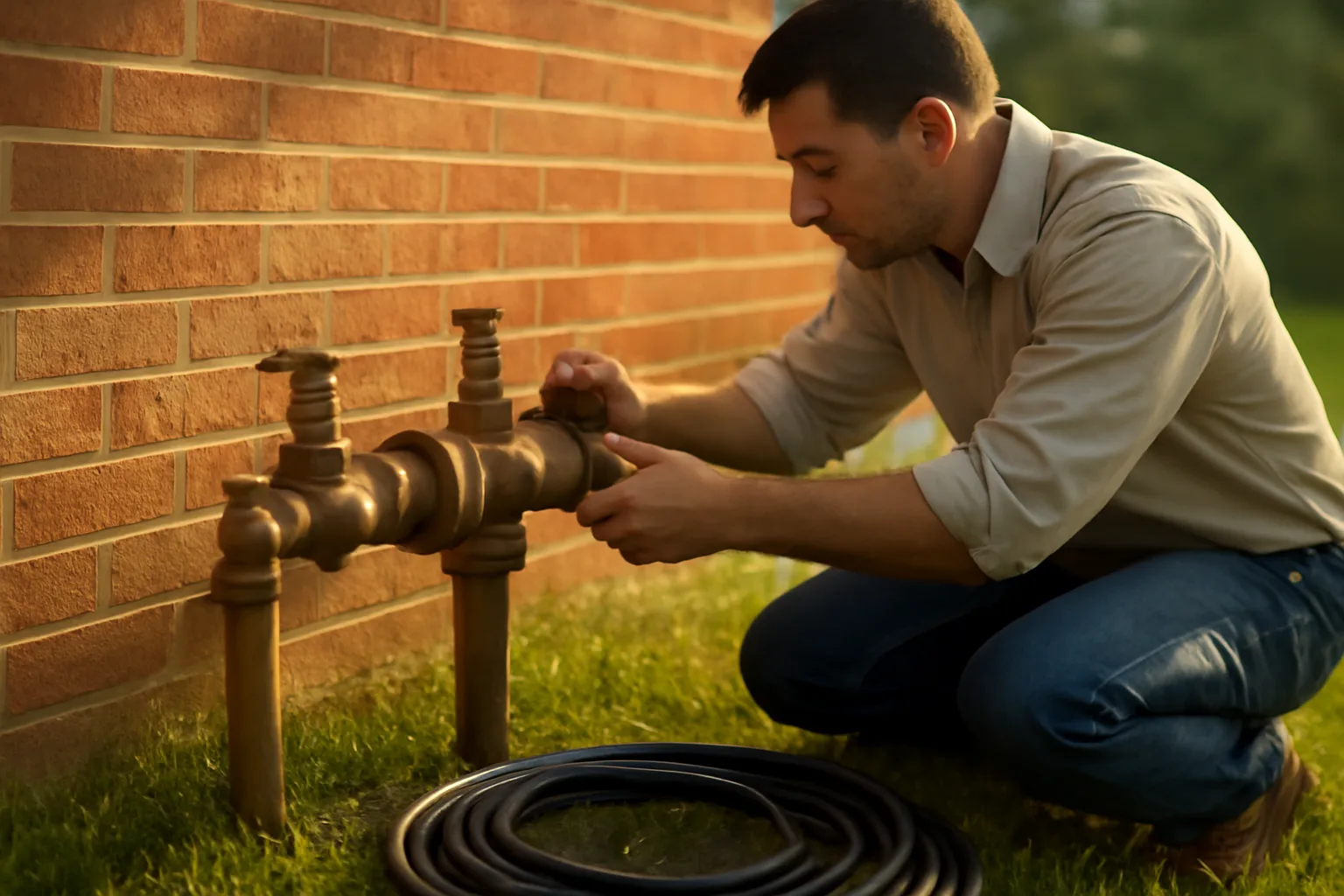
A backflow tester is a person who field-tests backflow prevention assemblies on potable water lines and files a report a water system will accept. You hook a differential-pressure gauge to a device, run a published procedure, and mark the assembly pass or fail. That is the job.
The work is public-health paperwork attached to brass. Reverse flow can pull chemicals, irrigation water, or worse into drinking lines. EPA's Cross-Connection Control Manual (EPA 816-R-03-002) states: "Backflow is the undesirable reversal of flow of water or mixtures of water and other liquids, gases, or other substances into the distribution pipes of the potable supply of water from any source or sources." [1] Testers exist because a utility cannot see that reversal from a desk.
OSHA says the same thing on the workplace side. 29 CFR 1910.141(b)(2)(ii) requires that nonpotable systems be built "to prevent backflow or backsiphonage into a potable water system." [2] Your test is how someone shows an assembly still does that on the day you were there.
A backflow tester is not automatically a plumber. Not a cross-connection control specialist. Not a water-system operator. Those are different cards, and mixing them up is how people sit through the wrong class.
If a device fails, you report it. Repair is a separate path in a lot of towns, and it often belongs to a licensed plumber. Know that split before you print business cards.
Is there a national backflow tester license?
No. The United States has no national backflow tester license. Skip the national myth and stop looking for it.
What you actually hold is a course credential plus whatever state or local paper the potable-water owner demands. California 17 CCR 7605 puts tester competency on the water supplier or health agency, not on a federal desk. [3] Texas is the clean counterexample. TCEQ issues a Backflow Prevention Assembly Tester license and also writes cross-connection duties for public water systems in 30 TAC 290.44. [4][5] Washington makes the purveyor run a program under WAC 246-290-490 and use qualified testers. [6] Florida puts the program on the public water system in FAC 62-555.360. [7] New York runs the duty through 10 NYCRR 5-1.31 and the state cross-connection program. [8]
Same gauge work. Different stamps. If you train in one state and move, you recertify or re-register. Do not assume reciprocity. I would call the receiving board before I paid for a second course.
ASSE 5110, ABPA, AWWA, and USC cards travel as coursework. They still are not a U.S. license. A city can refuse your card if you are not on its list, and plenty do.
How do you start as a backflow tester?
You start by reading the rule that can reject your report, not the school brochure. Find the state drinking-water chapter, then the local water purveyor's tester packet. Only then pick a course those names already accept.
Here is the sequence I would actually follow. Write down the utility name on the water bill. Download that utility's cross-connection ordinance or tester application. Read the state rule next to it. In Texas that is 30 TAC 290.44 plus the TCEQ BPAT license pages. [4][5] In Washington it is WAC 246-290-490. [6] In California it is 17 CCR 7605. [3] In Florida it is FAC 62-555.360. [7] Enroll in ASSE 5110, ABPA, AWWA, USC FCCCHR, or a state school only after the packet names it. [9] Pass the written exam and the hands-on exam. File with the state if the state licenses testers. Then get on each purveyor list you want to work in.
That last step is the one schools skip. Read the local list.
You also need a calibrated gauge, report forms the utility recognizes, and in many places a contractor license or a plumber license sitting under the tester card. Skip those and you will test for free in your driveway. Age and schooling rules are usually simple. Confirm both with the board that will take the card. I will not invent a processing time or a quota.
Aiming at California? Read the backflow tester board in california notes before you pay a school. Arizona and Florida are not the same packet. See Arizona backflow tester board: certification, costs, and timeline and backflow tester board in florida.
Which tester cards do boards actually take?
Boards take the card they named in writing. Ask for that sentence. Everything else is a maybe.
ASSE Series 5000 is the professional-qualifications family that includes the 5110 tester track. Schools love it because lots of ordinances already list it. The University of Southern California Foundation for Cross-Connection Control and Hydraulic Research still writes the field procedures many instructors teach, currently the 10th edition of the Manual of Cross-Connection Control. [9] ABPA and AWWA section programs show up on western and municipal lists. Texas often wants its own BPAT license on top of coursework. [4][11]
I would not pay for a second badge until a named purveyor asked for it. Stacking logos feels productive. It is usually just fees.
Use this as a starting map, then confirm. Rules move, and local amendments hide in utility PDFs.
| Place | Who papers the tester | Rule to read first |
|---|---|---|
| Texas | TCEQ BPAT license | 30 TAC 290.44 and TCEQ licensing [4][5] |
| California | Water supplier or health agency | 17 CCR 7605 [3] |
| Washington | Purveyor program with qualified testers | WAC 246-290-490 [6] |
| Florida | Public water system CCC program | FAC 62-555.360 [7] |
| New York | Supplier under the sanitary code | 10 NYCRR 5-1.31 [8] |
Massachusetts is another state-program example through MassDEP's cross-connection control program, which is not a national shortcut either. [12] If your state is not in that table, do not guess. Pull the drinking-water chapter and the utility packet.
Do you need a plumbing license to test?
Sometimes yes, sometimes no, and this is where first-year testers get stuck. The tester course does not replace a plumber license. A lot of cities let a certified tester perform the test and fill the report, then require a licensed plumber for repair, replacement, or any pipe that comes apart. Other cities will not even take a test report unless the tester already holds a plumbing or contractor license.
There isn't one national answer. Read the ordinance that governs the premises, not a forum post. If the site is a public water system in Texas, start with 30 TAC 290.44 and the TCEQ BPAT rules. [5][11] If it is Washington, start with WAC 246-290-490. [6] Plumbing codes sit next to those drinking-water rules, and they do not always agree.
My bias: get the tester card first only if your target utilities say a tester-only person can file. If they require a plumber underneath, spend the money on the plumber path and treat ASSE 5110 as an add-on. Doing it backwards burns a season.
Repair is separate work. Testing a failed RP and then rebuilding it without the right license is how people lose the right to test.
What first-year paper should you actually keep?
Keep the paper that gets a report accepted. That is a smaller pile than the schools imply.
You want your course certificate, the photo ID the board asked for, the wallet card if they issue one, the state license if you are in a license state, each purveyor approval letter or tester number, your gauge calibration certificate, blank test reports in the exact layout the utility wants, and a copy of every report you filed. Keep failed tests too. Utilities ask for them when a device keeps failing.
Texas testers should keep the TCEQ BPAT credential with the 30 TAC Chapter 30 Subchapter F file in mind, because that is the occupational-license chapter for this trade in that state. [11] California testers should keep whatever the water supplier used to "demonstrate competency" under 17 CCR 7605. [3] Washington testers should keep whatever the purveyor used to call them qualified under WAC 246-290-490. [6]
Some people buy a pre-built forms kit. ASSEPath sells a $149 one-time ASSE 5110/5115 Tester Kit if you want that stack collated. A used binder and the purveyor's own PDF work the same if you actually fill them in.
Do not laminate your only copy of a calibration cert. You will need to send scans. Do not store reports only on a phone. Phones die on a Friday before a deadline.
How much does it cost to start testing?
Nobody publishes a clean national price, and I will not invent one. You pay a school, an exam, a state or local registration if they charge, a gauge, annual gauge calibration, insurance if you work independently, and whatever plumber or contractor license your town quietly requires. Those line items move by state and by year. Confirm with the relevant board. No approval timeline is promised here.
The gauge is the line item people underbid. A real differential-pressure kit lands in the high hundreds to low thousands, then you pay again every year to keep the calibration current. Cheap marketplace gauges are a waste of money. Utilities bounce reports when the serial number does not match a lab sticker.
Course invoices vary hard by school and by whether a wet lab is included. Online-only classes look cheap until your board still requires a practical on real assemblies. Then you pay twice.
For a state-level budget, use a cost page that tracks that board, not a national average. Start with Backflow tester cost in California and how to budget, Backflow tester cost in Alabama: what you'll actually pay, and What backflow tester cost in Connecticut really includes. Those pages will still tell you to confirm live fees.
I would not buy a van wrap in year one. I would not buy three gauges. I would not pay a "national registry" upsell.
What rules apply to your test kit and gauge?
Your gauge is part of the legal test. If the calibration is stale, the report is junk, even if the RP looked fine.
Most utilities want a differential-pressure gauge of the type used in the USC 10th edition procedures, with hoses, adapters, and a current calibration certificate tied to the serial number. [9] Schools will tell you "annual calibration." That matches what field programs usually print. Confirm the interval on the purveyor form, because a few want tighter cycles or a named lab.
Write the gauge serial on every report. Take a photo of the sticker on site. When a clerk challenges a test six months later, that photo is the argument.
Do not borrow an uncalibrated shop gauge to "just get this one done." That is how you get dropped from a list. Do not mix hose colors until you can do the steps cold. The practical exam is where people fail, and it is usually hose discipline, not the written math.
EPA's 2003 manual is policy context, not a substitute for the field procedure your instructor named. [1] Use the procedure the board listed.
How do local water purveyors control testers?
The purveyor is the gate. State rules tell the water system to keep cross-connections under control. The water system then decides which humans may file a test. That is why a valid ASSE card can still bounce.
California is the blunt version. 17 CCR 7605 tells the water supplier to assure testing by people who have demonstrated competency to the supplier or the health agency. [3] Washington puts a full program on the purveyor in WAC 246-290-490. [6] Florida FAC 62-555.360 does the same at the public-water-system level. [7] New York's 10 NYCRR 5-1.31 and the state program sit on the supplier. [8] MassDEP's cross-connection program is another supplier-facing model. [12]
So you apply to the utility. You wait. You get a tester number or an email that says you are on the list. Then you test in that service area. Next town over, you apply again. It is tedious. It is the job.
Colorado and Georgia run their own mixes of state drinking-water rules and local lists. Read backflow tester board in colorado and backflow tester board in georgia before you assume your card ports.
Call the purveyor first. Ask which form they want and which cert names they will refuse. Get it in writing.
How do recertification and failed tests work?
Recertification is whatever your cert body and your board printed. Private tester credentials often run on a multi-year cycle with a refresher and another practical. State licenses can run on their own clock. I will not invent the number of months. Confirm with the board that accepts the card, and put the expiry on a calendar you actually look at.
Failed assemblies are normal. Your job is to record the fail, notify whoever the ordinance names (owner, purveyor, or both), and stop. If you also hold the license that allows repair, that is a second scope with its own parts and inspection rules. If you do not, walking away is the professional move.
Retests after repair are often required. Title 17 programs and WAC schedules commonly want testing on install, on repair, and at least annually. [3][6] EPA's 2003 manual pushed that annual idea into a lot of local programs. [1] The legal interval is still the local rule, not the manual's reputation.
Late recertification is how testers fall off lists in January. Do the class before the card dies.
What would I do in the first 90 days?
I would pick one utility, not five states. I would download that utility's tester packet and the state drinking-water rule on the same afternoon. I would call the cross-connection clerk and ask which course names they still take. Then I would enroll.
While the class is pending I would price a proper gauge and a calibration lab, not a kit from a marketplace listing with no serial history. I would ask an insurer about general liability for independent testers only if I plan to file reports under my own name. If I am testing under a plumbing shop, I would get the shop's name on the purveyor list instead of mine.
After the exam I would file state paper the same week if I were in a license state such as Texas. [4][11] I would submit the purveyor application the same week. I would not print 500 flyers. I would not test a friend's coffee shop "off the books" to practice. Illegal tests are how lists get short.
A printable path lives at /start. ASSEPath is an independent publisher, not a law firm and not a service company. The article still works if you never click that. The board packet is the document that matters.
Frequently asked questions
What is a backflow tester?
A backflow tester is a person who field-tests backflow prevention assemblies on potable water systems and files a pass or fail report the water purveyor will accept. You are proving the device still stops reverse flow. It is not a national job title and it is not the same card as plumber, CCS, or water operator.
How do you start as a backflow tester?
Read the local water purveyor's tester packet and the state drinking-water rule first. Enroll only in a course those documents name, pass written and practical exams, then register with the state if it licenses testers and with each utility you want to file in. Confirm fees and forms with that board. There is no national license.
Is ASSE 5110 a backflow tester license?
No. ASSE 5110 is a professional-qualifications tester track under ASSE Series 5000. Many ordinances list it as acceptable coursework. It still is not a U.S. license. Texas, for example, issues its own TCEQ BPAT license. California leaves competency sign-off with the water supplier under 17 CCR 7605.
Do I need a plumbing license to test backflow?
Depends on the town. Some utilities accept a tester-only person for the test and the report, then require a licensed plumber for repair. Others will not take a report unless a plumber or contractor license sits under the tester card. Read the ordinance for the premises. Doing the course first is a waste if the gate is the plumber license.
How often must backflow assemblies be tested?
Most state programs and utility rules want testing at least annually, plus after install, repair, or relocation. California 17 CCR 7605 and Washington WAC 246-290-490 are typical of that annual clock. Confirm the interval on the purveyor form. EPA's 2003 manual helped spread the annual habit, but the local rule is what binds you.
Can one backflow tester cert work in every state?
No. Reciprocity is limited and often unofficial. A card that a Florida utility takes may mean nothing to TCEQ or to a California water supplier. Call the receiving board before you pay for a second class. Plan on re-registering, and sometimes retesting, when you move.
What is the difference between a tester and a CCS?
A tester field-tests assemblies and files reports. A cross-connection control specialist (titles vary) surveys hazards, picks protection, and runs the program side. Washington's WAC 246-290-490 is a clear example of a purveyor program that is bigger than tester work. Do not sit a CCS class if you only needed the tester practical.
How often does a tester gauge need calibration?
Field programs usually want annual calibration of the differential-pressure gauge, with a certificate tied to the serial number. Confirm the interval and any named lab on the purveyor form. Put the serial on every report. An uncalibrated or mismatched gauge is a common reason utilities bounce tests.
Who do I submit backflow test reports to?
The water purveyor that owns the potable system, and sometimes the premises owner, on the exact form that utility issued. State agencies generally do not want your daily stack unless they are the licensing body. Ask the cross-connection clerk how they take filings (portal, email, paper) before you test the first device.
What if an assembly fails the test?
Record the fail, notify whoever the ordinance names, and stop if you are not licensed to repair. Retest after competent repair. Walking away is not optional ethics. It is how you stay on the list. Rebuilding an RP without the right plumbing license is a fast way to lose tester privileges.
Are online-only backflow tester courses accepted?
Sometimes the lecture is online. The practical almost always is not. Boards still want you to test real assemblies with a gauge. I would not buy an online-only package unless the named board said in writing that it replaces the wet lab. Most of the time you will pay twice.
Should I form an LLC before I test?
Not first. Get a purveyor that will take reports under your name, get the gauge, and get insurance if you are independent. An LLC without a list number is stationery. If you test under a shop, their name on the utility list matters more than your entity paperwork.
What field procedure do most schools teach?
Many U.S. tester courses still teach the University of Southern California Foundation procedures from the Manual of Cross-Connection Control, 10th edition, covering RP, DC, PVB, and SVB tests. Your board may name that manual, ASSE, AWWA, or a state procedure. Use the one on the exam sheet, not a mix of YouTube methods.
Sources
- U.S. EPA, Cross-Connection Control Manual (EPA 816-R-03-002): Defines backflow as the undesirable reversal of flow into potable distribution pipes and is the 2003 federal manual used by state programs.
- OSHA, 29 CFR 1910.141 Sanitation: Requires nonpotable systems to be constructed to prevent backflow or backsiphonage into a potable water system.
- California Code of Regulations, Title 17, section 7605: Requires the water supplier to assure testing and maintenance of backflow preventers by persons who have demonstrated competency to the supplier or health agency.
- 30 Texas Administrative Code §290.44: Sets public water system water-distribution and cross-connection control duties in Texas, including backflow protection.
- Washington Administrative Code 246-290-490: Requires public water purveyors to implement a cross-connection control program and to use qualified persons to inspect and test backflow preventers.
- Florida Administrative Code 62-555.360: Requires Florida public water systems to have a cross-connection control program addressing backflow.
- New York State Department of Health, Cross Connection Control program: New York administers cross-connection control for public water systems under the state sanitary code, including 10 NYCRR 5-1.31.
- USC Foundation for Cross-Connection Control and Hydraulic Research: Publishes the Manual of Cross-Connection Control (10th edition) whose field-test procedures are widely taught to testers.
- 30 Texas Administrative Code Chapter 30, Subchapter F: Contains TCEQ occupational licensing rules that apply to Backflow Prevention Assembly Testers in Texas.
- Massachusetts Department of Environmental Protection, Cross Connection Control Program: MassDEP runs a state cross-connection control program that public water suppliers and testers must follow in Massachusetts.