Last updated 2026-08-21
TL;DR
A backflow tester field-tests assemblies that stop contaminated water from reversing into potable lines. There is no U.S. national license. Start with a course your state or water purveyor accepts, pass the written and practical exam, get listed or licensed where required, then keep gauges calibrated and recertify on that board's clock. Confirm forms with the agency that files your reports.
What is a backflow tester?
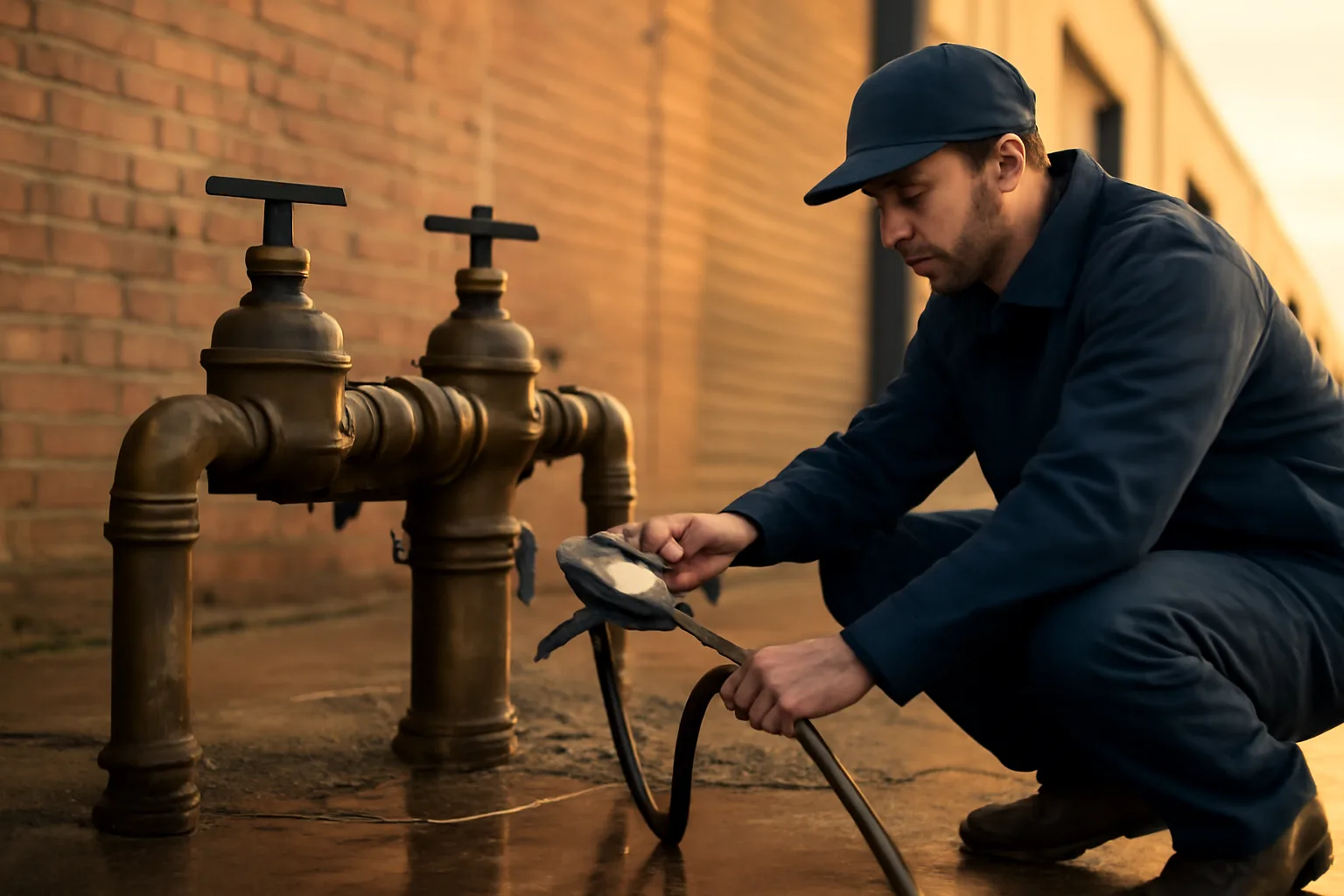
A backflow tester field-tests the mechanical assemblies that keep nonpotable water from reversing into a drinking water line. That is the job on paper. You connect a differential pressure gauge to test cocks, record the readings against the assembly type, and mark a pass or fail that a water purveyor keeps on file.
The EPA Cross-Connection Control Manual (EPA 816-R-03-002) names the problem you are paid to catch. "Backflow is the undesirable reversal of flow of water or mixtures of water and other liquids, gases, or other substances into the distribution pipes of the potable supply of water from any source or sources." [1]
You are not the utility. You are not automatically a plumber. You are the tester whose numbers the supplier keeps. Reduced pressure principle assemblies (RP or RPZ), double check assemblies (DC or DCVA), pressure vacuum breakers (PVB), and spill-resistant vacuum breakers (SVB) are the usual lineup. Fire-line double checks show up on bigger sites. An air gap is a method, not a gadget you test with a gauge.
The work is local. A city can reject a report from a card it does not list. National myths waste a winter. If you want a career-neighbor comparison, read backflow tester vs nearby career. Testers who also hold a plumbing license can repair failed assemblies in more shops. Testers who hold only a tester card still eat, as long as they stay on the district list.
EPA also reviewed documented backflow incidents and health effects in a 2007 issue paper for the Total Coliform Rule. The paper is old. The hazard is not. [10] Treat every assembly as if someone downstream drinks whatever you miss.
Is there a national backflow tester license?
No. There is no U.S. national backflow tester license. The Safe Drinking Water Act sets national drinking water rules for public water systems. It does not issue your tester card. [1] States, counties, and individual water purveyors decide who may test, which school they trust, and which form they file.
Washington requires public water systems to run a cross-connection control program under WAC 246-290-490, including inspection and testing of assemblies at installation and annually after that, or more often if the purveyor says so. [2] New York puts cross-connection control on the supplier in 10 NYCRR 5-1.31. [3] Florida Rule 62-555.360 requires public water systems to establish a cross-connection control program. [4] Texas writes distribution-side cross-connection control into 30 TAC §290.44. [5] California Title 17 section 7605 requires backflow preventers to be tested at least annually. [6]
Those rules protect water. They do not create one card you can flash in every state. ASSE 5110 is a professional qualification many boards recognize. It is still not a federal license. USC's Foundation for Cross-Connection Control and Hydraulic Research is another training lineage utilities respect. A state license such as a TCEQ Backflow Prevention Assembly Tester card is its own paper. [8]
Ignore any ad that says one weekend makes you legal everywhere. Call the purveyor that will receive your first report. Ask which list they use. Then train to that list.
How do you start as a backflow tester?
You start by picking one jurisdiction, not four. Call the water purveyor or state drinking water program and ask three things: which tester credential they file, which schools they accept this year, and which report form they want. Write the answers down. Then enroll in that course, pass the written and hands-on exam, and get on the list before you buy extra cards.
The course is usually a multi-day class with live assemblies. Expect a written test and a practical on an RP, a DC, and a PVB or SVB. Do not skip the practical. Boards that still watch testers fail people on gauge hookup, not on vocabulary. After you pass, you apply to the state board, the county, or the purveyor's tester roster. Texas, for example, licenses testers through TCEQ as Backflow Prevention Assembly Testers. Confirm the current application packet with TCEQ. Do not trust a blog for the form number. [8]
Buy a real differential gauge kit after you know the listing rules. Cheap auction gauges are a waste. You will also need calibration on that board's clock, often yearly, from a lab the listing agency accepts. Get general liability insurance before you touch a customer's assembly. Some districts want a copy of the certificate on file.
Paper path in short: accepted course, exam, listing or license, calibrated kit, insurance, then the local test form. A longer checklist lives in backflow tester guide 12. Confirm every blank with the board that files the report. Nobody can honestly promise an approval date. Processing clocks move, and they are local.
Which tester credential will a water board actually file?
The credential a water board will file is the one that board named in writing. Ask for it. Do not collect logos. ASSE 5110 (tester) and ASSE 5115 (repairer) are common course targets. So are state BAT or BPAT licenses, AWWA local tester programs, and USC-style certificates. A card that impresses a Facebook group can still bounce at the utility counter.
Here is a board-confirmable snapshot. The intervals below are the code floor, not a promise the purveyor will not tighten them.
| Place | Tester paper to confirm | Code floor on testing | Where to verify |
|---|---|---|---|
| California | Person the supplier or health agency accepts | At least annually (17 CCR 7605) | Local water supplier / health agency [6] |
| Washington | Certified backflow assembly tester under the CCC program | At installation and annually (WAC 246-290-490) | Purveyor / DOH [2] |
| Texas | TCEQ BPAT license | PWS cross-connection rules in 30 TAC 290 | TCEQ licensing + PWS [5] [8] |
| New York | Tester the supplier and local health unit accept | Supplier CCC under 10 NYCRR 5-1.31 | County health / PWS [3] |
| Florida | Tester named in the system's CCC program | Program required by 62-555.360 | PWS / DEP [4] |
Take the class the first paying district lists. A second credential is optional after you have reports on file. Dual logos in month one are mostly theater.
Do you need a plumber license before you test?
Sometimes you need a plumber license. Often you do not. Testing and installing are different paper piles. Many states let a listed tester test without a journeyman card. Repair, rebuild, or replacement is where plumbing contractor rules kick in. Texas splits this: TCEQ licenses the tester, while plumbing contractor rules still govern pipe work. Confirm both. [8]
Cities can be stricter than the state. A town may let you test with a BAT card and still require a licensed plumber to swap a failed RP. Fire-line work can drag in a fire-protection contractor license. Irrigation backflow can sit under a landscape contractor board. Do not assume your tester card covers a wrench.
If your plan is test-only, say that out loud to the purveyor and to your insurer. Test-only is a real business. It just means a failed assembly becomes a referral, not a change order. If your plan is test-and-repair, budget the plumbing or fire ticket before you print door hangers. A walkthrough of adjacent tickets is in backflow tester guide 24.
BLS does not publish a clean tester-only wage. The Bureau of Labor Statistics lists median annual pay for plumbers, pipefitters, and steamfitters at $62,970 (May 2024). [7] That occupation is a cousin, not your exact job. Tester-only shops can land under or over that number depending on how dense the assemblies are and how ugly the access is.
How often do backflow assemblies have to be tested?
Most assemblies you will see need a test at least once a year, plus a test at install, repair, or relocation. California Title 17 section 7605 says, "Backflow preventers shall be tested at least annually or more frequently if determined to be necessary by the health agency or water supplier." [6] Washington WAC 246-290-490 requires inspection and testing of assemblies at installation and annually after installation. [2]
The purveyor can shorten that. High-hazard RPs at hospitals, mortuaries, or chemical plants often get a tighter clock. New assemblies get tested before they go in service. After a backflow incident, expect an extra test even if the sticker is still in date. Do not argue the calendar with the water department. They own the program.
Florida and New York put the program on the public water system, which then tells you the interval on the account. [3] [4] Texas writes the duty into its distribution rules, and the system passes the schedule to the customer. [5] The paperwork travels the same way in most states: the code sets a floor, the supplier sets the due date, and you fill in the readings.
Print the local interval on your work order so the customer sees it. Annual is the common floor. It is not a federal statute with your name on it. Confirm the due month with the agency that sends the customer the nastygram.
What paper does a backflow tester file after a test?
You file the form that district uses, on the portal or carbon that district named. Typical fields: assembly location, make, model, size, serial number, line pressure, the differential or opening-point readings, pass or fail, gauge serial, calibration date, your cert number, and a signature. Some utilities still want three-part paper. Some want a CSV upload by 5 p.m. the same day.
A failed test usually triggers a repair deadline. The customer owns the assembly. You own the accuracy of the readings. If you fail it, write the fail clearly. Do not "almost pass" a leaking RP to keep a property manager happy. That report is drinking water paper.
Keep a copy. Keep the gauge calibration cert next to it. If a health inspector asks in November what you did in March, you want the scan, not a memory. Related form notes sit in backflow tester guide 36.
Skip the custom app in month one. A folder of PDFs and the utility's own portal beat a $200 per month SaaS you will abandon. Once you have a few hundred tests, software can pay. Until then it is overhead.
ASSEPath publishes a $149 one-time ASSE 5110/5115 Tester Kit if you want the paper stack in one pile. The kit does not replace the board's form. The board still wants its own form.
What does first-year work look like in practice?
First year is listing, access, and weather. You will spend as much time hunting shutoff keys and locked gates as you spend on the gauge. Commercial RPs sit behind dumpsters. Residential PVBs sit in shrub beds. Fire-line assemblies sit in noisy rooms with no drain. Meter pits can be permit-required confined spaces under OSHA 29 CFR 1910.146. If you cannot see the bottom, do not pretend it is a shallow box. [9]
Volume is all over the map. A tester tied to one mechanical contractor might do a handful of tests a week. A tester who gets on three large city lists in a dense metro can fill the spring. Nobody has a clean national count of tests per new tester. The closest labor picture is still the plumber occupation at BLS, which mixes in a lot of pipe work you may never touch. [7]
Spring is the crush because annual notices land then. Winter is vaults, heat tape, and reschedules. Keep a simple route list by due month, not by who yelled last. Property managers will try to batch 40 assemblies on a Friday. Say no if the last one will be in the dark.
Dress for wet brass and dog yards. Carry extra hose gaskets. Carry a dump bucket. Carry the SDS for any cleaner you use on test cocks. First-year field notes continue in backflow tester guide 48. The glamorous part is a dry notebook.
How much does it cost to get started as a tester?
Course plus exam is often several hundred dollars to a bit over a thousand, depending on the school and whether lunch and the exam retake are included. There is no national fee table that stays true for 90 days. Confirm the invoice with the school your board lists. License or listing fees are separate and local. TCEQ, a county health department, and a city water desk will not match. Confirm with that board. Do not use a number you saw on a forum in 2019. [8]
The real check is the gauge kit. A proper differential kit with fittings for RP, DC, and PVB work commonly runs well into four figures new. Rebuild kits, extra hoses, and a calibration are on top. If a kit is cheap enough to feel like a bargain from a random seller, it is probably a calibration problem with your name on it.
Insurance is not optional if you step on private property. Ask a commercial broker for general liability that names testing. Some districts want to be additional insured. Vehicle, phone, and a laptop you already own may be enough in year one. A full wrap on the truck is a waste until the phone rings.
Skip the extra-state class until a second district puts a paying account in writing. Skip the $4,000 data platform. Spend on calibration and a gauge you can defend.
How do you keep a tester credential after year one?
You keep it by recertifying on that issuer's clock and by staying on the list that files your reports. ASSE tester credentials are commonly on a three-year recert cycle, but the body that issued yours is the one that counts. State BAT cards can run shorter. Some cities make you sit a local update even if ASSE is still green. Confirm the date. Put it on a paper calendar, more than a phone.
Gauges need calibration on the interval the listing agency named. Annual is common. If your sticker lapses in June and you test in July, expect the report to bounce. Keep the lab cert in the same folder as the tester card. Recert classes fill up in the month everyone expires. Book early.
Ethics are part of keeping the card. Fake serial numbers, pencil-whipped differentials, and "tested from the sidewalk" reports get people dropped from lists. Water programs talk to each other inside a metro. One blown account can follow you.
If you let the card lapse, you start the application again. There is no graceful national grace period. More recert detail is in backflow tester guide 60. Recert before the busy season, not during it.
Can one backflow tester card cover more than one state?
Rarely as a single card, and never as a right. Reciprocity is a courtesy some neighbors extend, not a compact. A Washington BAT does not automatically become a TCEQ BPAT because you drove south. [2] [8] A California tester accepted by one supplier may still need a different local listing two counties over. [6]
If you live on a border, ask both programs in writing. Some will accept an ASSE 5110 plus a short local exam. Some will make you sit the full practical again. Fire districts and irrigation districts can add a third yes. Budget time, not optimism.
Do not print "licensed in 12 states" on a van. Print the two lists you can actually upload to. Multi-state work also multiplies insurance filings, tax registration, and confined-space rules. OSHA's confined-space standard does not care which tester school you liked. [9]
When a customer with sites in three states wants one vendor, be honest. You can subcontract the other states or get the second card. Pretending is how reports get rejected in August when the customer's occupancy depends on a pass.
What is a waste of money in the first year?
A second state card with no account behind it is a waste. So is a bargain gauge with no calibration trail. So is door-hanger spam in a city that assigns testers from a closed list. So is a full wrap on the truck before you have a route. So is software with a seat license higher than your monthly test count.
Here is what I would spend on: the class the first purveyor named, a defensible kit, calibration, liability insurance, and shoes you can stand in for ten hours. Here is what I would do on day one: request the tester handbook and the current report form, then take one practice test on a spare assembly until the hookup is boring.
This page is a reference, not an application. Boards change packets. Fees move. Confirm the live form with the agency that will file your report. For a later checklist in this series see backflow tester guide 72. If you want the optional paper kit path, it is at /start.
The job is simple to describe and picky to keep. Test the assembly. Tell the truth on the form. Stay calibrated. Stay listed. That is the whole paper path.
Frequently asked questions
What is a backflow tester?
A backflow tester field-tests assemblies that stop contaminated water from reversing into potable piping. You use a differential gauge, record pass or fail readings, and file the form the water purveyor named. It is a local credential, not a federal occupation title. Repair work is a separate paper pile in many cities.
How do you start as a backflow tester?
Pick one water purveyor or state program. Ask which course, exam, and report form they accept this year. Take that class, pass the written and practical, get listed or licensed, then buy a calibrated gauge kit and liability insurance. Confirm every fee and form with that board. No one can honestly promise an approval date.
Is ASSE 5110 required in every state?
No. ASSE 5110 is a widely used tester qualification, not a national license. Some boards want it. Some want a state BAT or BPAT card. Some want a local AWWA or USC-style certificate. The only credential that matters is the one the agency that files your reports listed in writing.
Do you need a plumber license to test backflow assemblies?
Often no for test-only work, and often yes if you repair or replace the assembly. Cities and fire districts can be stricter than the state. Texas licenses testers through TCEQ while plumbing contractor rules still govern pipe work. Ask the purveyor and the plumbing board before you print "repair" on a flyer.
How long is backflow tester school?
Most accepted courses run multiple days with live assemblies and a practical exam. People loosely quote 32 to 40 hours, but the school your board lists sets the clock. Do not pick a course by hour count. Pick the one the first paying district will file. Confirm the current schedule with that school.
How much does a backflow test kit cost?
A proper differential gauge kit with fittings commonly costs well into four figures new, plus calibration. Course and license fees are separate and local, so confirm those invoices with the school and the board. Bargain gauges without a calibration trail are a waste. Do not use a forum price from years ago.
How often do you recertify as a tester?
Follow the issuer. ASSE tester cards are commonly on a three-year recert cycle, while some state or city listings run shorter and may add a local update. Gauge calibration is often yearly. Put both dates on a paper calendar. If the listing lapses, you usually reapply rather than glide on a national grace period.
Who gets the backflow test report?
The water purveyor or the local health unit that runs the cross-connection program gets the report, on their form or portal. The customer should get a copy. You keep a copy with the gauge calibration cert. A failed test usually starts a repair deadline the customer owns. Do not invent a pass to keep a property manager calm.
Can a new tester work on fire-line assemblies?
Only if the listing and any fire-protection contractor rules say so. Fire-line double checks are still backflow assemblies, but access, shutdowns, and repair limits are pickier. Some sites want a fire contractor on the wrench even when you hold the tester card. Ask the purveyor and the fire marshal before you bid a riser room.
What is the difference between a tester and a repairer?
A tester diagnoses pass or fail. A repairer rebuilds or replaces internals, which is why ASSE 5115 exists as a separate qualification in shops that use the ASSE series. Many jurisdictions let you test without a repair ticket and forbid you to turn a wrench without plumbing or fire contractor paper. Confirm both scopes.
Do backflow gauges need calibration every year?
Annual calibration is the common listing rule, but the agency that accepts your reports sets the interval and the lab they trust. A lapsed sticker is a bounced report. Keep the cert with the tester card. I would calibrate before the spring rush, not after the first rejection.
Can you test in two states on one card?
Almost never as a right. Reciprocity is local courtesy. A Washington tester card does not become a TCEQ BPAT because you crossed a line. If you work a border, ask both programs in writing and budget a second exam. Print only the lists you can actually upload.
Sources
- U.S. EPA, Cross-Connection Control Manual (EPA 816-R-03-002): Defines backflow as the undesirable reversal of flow of water or other substances into potable distribution pipes
- Washington WAC 246-290-490 Cross-connection control: Public water systems must implement a CCC program; assemblies are inspected and tested at installation and annually
- New York 10 NYCRR §5-1.31 Cross connection control: New York drinking water suppliers must protect public water systems against cross-connections
- Florida Administrative Code Rule 62-555.360: Florida requires public water systems to establish cross-connection control programs
- 30 Texas Administrative Code §290.44 Water distribution: Texas public water systems must control cross-connections in the distribution system
- California Code of Regulations, Title 17, §7605: Backflow preventers shall be tested at least annually or more frequently if the health agency or water supplier requires it
- U.S. BLS Occupational Outlook Handbook, Plumbers, Pipefitters, and Steamfitters: Median annual wage for plumbers, pipefitters, and steamfitters is $62,970 (May 2024)
- OSHA 29 CFR 1910.146 Permit-required confined spaces: Pits and vaults that house assemblies can meet the federal definition of permit-required confined spaces
- U.S. EPA, Potential Contamination Due to Cross-Connections and Backflow (TCR issue paper, 2007): EPA reviewed documented backflow incidents and associated public health effects