Last updated 2026-08-21
TL;DR
A backflow tester is the person a water purveyor will accept to field-test a backflow prevention assembly and file the signed report. There is no national tester license. You take the course and exam your local supplier lists (often ASSE 5110, USC, ABPA, or a state card), then get on their tester list. Confirm the board and the purveyor before you buy gauges. Year one is paper, a calibrated differential-pressure kit, and getting listed.
What is a backflow tester?
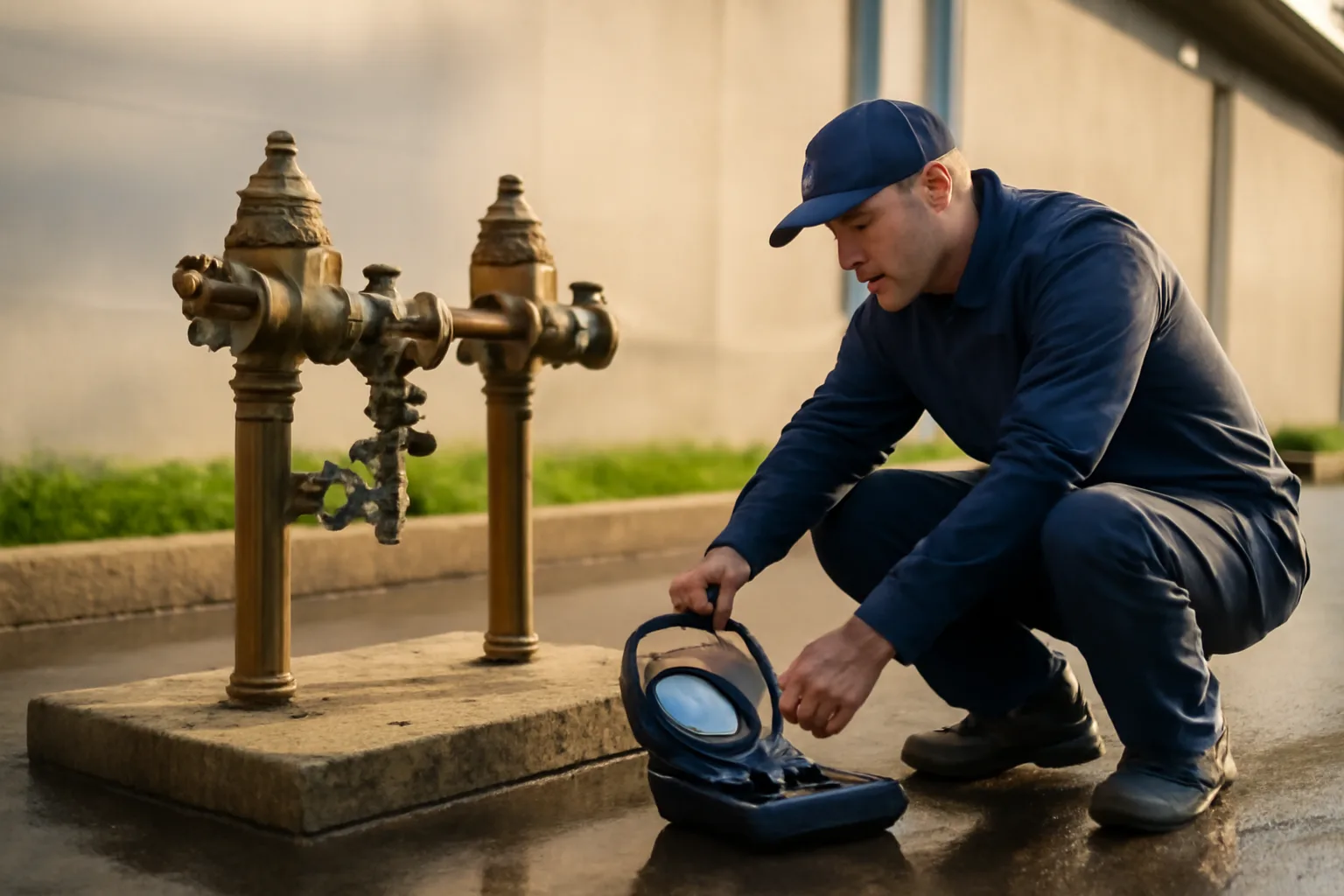
A backflow tester is the person a water purveyor, fire official, or building department will accept to field-test a backflow prevention assembly and sign the report they keep on file. You measure whether a mechanical device still stops water from running the wrong way. You are not automatically a plumber, a water operator, or a cross-connection surveyor.
The job exists because a potable system can pull or push nonpotable water backward through a connection. The U.S. Environmental Protection Agency Cross-Connection Control Manual (EPA 816-R-03-002) states: "Backflow is the undesirable reversal of flow of water or mixtures of water and other liquids, gases, or other substances into the distribution pipes of the potable supply of water from any source or sources." [1]
That reversal shows up two ways. Backsiphonage when supply pressure drops. Backpressure when downstream pressure beats the street main. Reduced pressure principle assemblies, double check valves, pressure vacuum breakers, and spill-resistant vacuum breakers are the hardware you test most days. Fire-line versions of the same families show up too, and some authorities want a separate card for those.
A tester's product is a completed report plus a pass or fail. Fail means the assembly did not meet the performance the local program wrote down. Pass does not mean the building is safe in every other way. It means this device, on this day, with this gauge, met the test.
If a water supplier will not put you on their tester list, you do not have a job there. The card in your wallet is only half of it.
How do you start as a backflow tester?
You start by matching the credential your target water purveyor already lists, taking that exact course and exam, then getting on the local tester list. There is no federal tester license. States and cities fill the gap, and they do not copy each other.
Here is the path I would actually walk.
Pick the city or utility you can drive to in the first year. Call the cross-connection control desk and ask which certifications they accept this year. Write the names down. If they say ASSE 5110, USC Foundation, ABPA, AWWA, or a state license such as a Texas BPAT, that is your shopping list. Do not buy a course until that call is done.
Sit an approved school. Most tester courses run about a work week, with wet tests on a bench plus a written exam and a hands-on exam. Pass both. Then file whatever the state or the purveyor wants next.
Texas treats this as a TCEQ license under 30 TAC Chapter 30, Subchapter D. [3] Washington treats it as a Department of Health Backflow Assembly Tester credential. [8] California is messier. Local water suppliers still decide who may test in their service area, on top of statewide cross-connection rules. [5]
Buy or rent a calibrated differential pressure gauge kit after you know you passed. Get insurance if you will hang a shingle. Then do the dull part: get listed, learn each utility's report portal, and keep calibration certificates.
Skip nationwide work-anywhere packages. They waste money.
Is there a national backflow tester license?
No. There is no national backflow tester license, and the Safe Drinking Water Act does not issue one. EPA publishes guidance. States, primacy agencies, and water purveyors write the rules that decide whether your report counts. [1]
People sell the myth because ASSE 5110, ABPA, and the USC Foundation course travel well on a resume. Travel is not the same as authority. A card from a national body is only useful where a local program wrote that name into its accepted-certification list.
Washington law puts certified testers inside the public water system's cross-connection control program. WAC 246-290-490 says the purpose of the section "is to protect the public water system from contamination due to cross-connections." [2] That is a state health rule, not a trade association slogan.
Texas goes further and licenses the tester. 30 TAC Chapter 30, Subchapter D is the Backflow Prevention Assembly Tester license chapter. [3] You do not get to skip TCEQ because you already own an ASSE wallet card.
Florida's drinking-water rule requires community water systems to run a cross-connection control program under FAC 62-555.360. [7] The utility program, not a national office, decides which tester credentials it will file.
Anyone telling you one course covers all 50 states is selling. Check the backflow tester board in arizona write-up if the Southwest is your first market, then call that board anyway.
Which credential do water purveyors actually accept?
They accept the names printed in their current tester policy, which is usually a short list. Common entries are ASSE 5110, USC Foundation tester certification, ABPA, an AWWA section tester program, or a state license. Ask for the list in writing. Verbal lists change when a new specialist takes the desk.
Washington's Department of Health runs its own Backflow Assembly Tester program and posts the requirements on the BAT certification page. [8] To test assemblies that protect a Washington public water system, that DOH path is the one that matters, not a generic online badge.
Texas public water systems must protect the supply from backflow under 30 TAC 290.44. The rule's backflow subsection opens with: "No water connection from any public drinking water supply system shall be made to any establishment where an actual or potential contamination hazard exists unless the public water supply is protected from contamination." [4] Testers who want those reports accepted need the TCEQ BPAT license, not a hope that an out-of-state card will clear the portal. [9]
California Health and Safety Code section 116800 directs the state to adopt cross-connection regulations. [5] Title 17, section 7605 has long required testing at least annually and put the water supplier in the middle of notice and records. [6] You still get listed with each purveyor. See backflow tester board in california for the board-shaped part of that mess, then call the water district you will actually drive.
Massachusetts puts cross-connection control in 310 CMR 22. [10] Florida testers live inside each utility's FAC 62-555.360 program. [7] For a Florida-shaped checklist, use backflow tester board in florida and then the utility packet.
Colorado is another local-list state sitting on top of Regulation 11 style drinking-water rules. Confirm on the backflow tester board in colorado page, then with CDPHE and the purveyor. Do not assume the same initials work in Denver and in Grand Junction.
What do training, exams, and recertification look like?
Plan on a full-time course of about one week, a written test, and a hands-on test where you set up a gauge and diagnose a known assembly. I would not trust a course that never gets you wet. The whole job is wet.
Exact hours are not uniform. Texas, Washington, and many USC-style schools cluster around a multi-day bench course. Some states tack on a separate application, a jurisprudence quiz, or a photo for a license card. Confirm hours with the board that will print your name. Nobody should quote you a national hour count as law.
The performance exam is where people fail. You must connect the differential pressure gauge to the test cocks in the right order, record the relief-valve opening point on an RP, and spot a leaking check. If you cannot do that without a coach whispering, you are not ready to charge a customer.
Recertification is also local. Many tester programs run on a three-year cycle. Some want CE hours. Some want a retest. Some want both. Washington BAT renewal is a DOH process, not an ASSE process. [8] TCEQ BPAT renewal is a TCEQ process. [9] Do not let a school auto-bill you for a recert your state will not honor.
Keep the course roster, the score sheet, and the certificate PDF in one folder. Purveyors ask for them years later when they audit their tester list. If you cannot produce the paper, you get dropped, and your backlog dies with the listing.
What paper and tools do you need in year one?
Year one is a thin stack of paper and one honest gauge kit. You need the certificate or license the purveyor listed, a photo ID, a current gauge calibration certificate, blank test reports in the format each utility wants, and a way to submit them (portal login, email, or carbon forms). That is the job.
The gauge is a differential pressure gauge with the hoses, adapters, and fittings for the assemblies you will see. Most programs want that gauge calibrated at least once a year by a shop they recognize. If the cert is expired, your report is trash. I would buy a used kit from a known maker with a fresh cert before I bought a shiny no-name kit with a pretty case.
You also need a way to record serial numbers, meter numbers, hazard type, and assembly location. Phone photos of the data plate save you when the tag is caked in mud. Do not invent a serial number. Utilities catch that.
ASSEPath sells a $149 one-time ASSE 5110/5115 Tester Kit if you want forms and a paper checklist in one binder. You can build the same file yourself with free utility PDFs and a folder.
Repair parts are a different business. Tester credentials do not automatically make you a repairer. ASSE splits tester and repairer qualifications for a reason. If you swap a check without the repairer paper your town wants, you can void the test and the warranty in one afternoon.
Winter work needs freeze discipline. An RP that dumps water will ice a pad. I would rather reschedule than crack a relief valve and then argue about who pays.
How much does first-year backflow tester work cost to set up?
I will not quote you a fake national fee. Course tuition, exam fees, state license fees, listing fees, gauge kits, calibration, insurance, and truck costs all move by state and by year. Confirm every dollar with the board and the school that will take your money.
What I can tell you is the shape of the bill. The course is usually the first check. The state application, if any, is the second. The gauge kit is the third, and it can dwarf the class if you buy new. Calibration is a recurring line. Insurance is a recurring line if you test as an independent. Portal fees and late-report fines show up after you think you are done.
Texas BPAT applicants pay TCEQ whatever the current license table says. Look it up on the TCEQ BPAT page. Do not copy a blog number. [9] Washington BAT applicants pay DOH whatever that page lists now. [8] California testers often pay a school, then a county or a water district listing fee on top. Budget that extra listing, which is easy to miss. backflow tester cost in California and how to budget is the cost-shaped companion for that state.
If Alabama is your first market, read Backflow tester cost in Alabama: what you'll actually pay and then the local water board. Connecticut testers should do the same with What backflow tester cost in Connecticut really includes.
I would not finance a new van for this. First-year tester work is dense in older commercial strips, apartments, and irrigation season. A reliable small truck and a calibrated kit beat a wrap and a logo. Spend on calibration and on getting listed in two neighboring utilities, not on branding.
Who hires testers and what makes a report stick?
Water purveyors, property managers, fire-line contractors, plumbing shops, and irrigation companies hire testers. The customer who pays you is often not the authority who accepts the report. The water supplier or the fire AHJ is the real audience. Write the report for them.
A report sticks when it uses the utility's form, the assembly's real serial number, the tester number they issued you, the gauge serial and calibration date, and the pass/fail method they specified. Close the test cocks. Note if you could not test. A pretty PDF with the wrong site address gets rejected.
Washington programs live under WAC 246-290-490, so the purveyor is on the hook for a working cross-connection control program and for using certified testers on the assemblies that protect the public system. [2] Your field notes become their sanitary-survey evidence. Treat them that way.
Texas suppliers are reading 30 TAC 290.44 when they decide whether a connection is even legal. [4] Pass an assembly that does not match the hazard and you helped nobody. Hazard classification is usually the purveyor's call, not a freelancer's opinion on the tailgate.
Turnaround matters. Many districts want results within a short window after the test. Ask what "short" means. I would rather test fewer devices and file same day than build a weekend pile that misses a shutoff deadline.
If a customer asks you to "just pass it," walk. That request is how testers lose listings. The listing is the business.
How often do backflow assemblies need testing?
Most programs require a test on installation, after repair, and at least once a year. That annual cycle is the drumbeat of tester work. It is also why spring and early summer fill a calendar and February can go quiet in cold states.
California Title 17, section 7605 has long said this testing "shall be done at least annually," with the water supplier notifying the user when a test is due. [6] Washington's WAC 246-290-490 likewise puts inspection and testing of protecting assemblies on a recurring schedule inside the purveyor program, including after install and repair. [2] Texas 30 TAC 290.44 folds testing into the public-water protection rules for required assemblies. [4]
Some hazards get tighter intervals. A hospital RP may be on a shorter leash than a lawn double check. That is a local call. Do not invent a six-month rule unless the purveyor wrote it.
New assemblies need a test when they go in, even if the calendar says the old one was due next fall. Repairs reset the clock in most programs. If you change a check, test it before you leave the pad.
Florida's FAC 62-555.360 makes the utility write a program. [7] Frequency then lives in that program, which is why two neighboring Florida cities can nag you on different months. Read the utility packet, not a Facebook group.
Annual testing is also why gauge calibration on a 12-month rhythm matches the work. A gauge that expired in March will poison every April report.
Do you also need a plumbing or contractor license?
Sometimes. Tester paper and contractor paper are different stamps. A water department can accept your test report while the city licensing desk still says you cannot advertise plumbing or pull a permit. Ask both desks.
Test only, break no union, and some towns let you work under the water program alone. The minute you repair, replace, or relocate an assembly, you are in plumbing or fire-sprinkler contractor territory in a lot of cities. Fire assemblies are the sharp edge. Many fire officials want a fire-line contractor on the wrench even if you hold a domestic tester card.
I would not hang a yard sign that says "backflow testing and repair" until I read the contractor chapter. That sign is how people collect stop-work orders.
Employer shops solve this by putting testers under an already licensed contractor. If you are new, that is the cleaner first-year path. You learn the portals, you skip the fight with the business-license office, and you still get bench time.
Insurance follows the same split. A tester doing visual tests and gauge work is one risk class. A person cutting in a new RP is another. Tell the insurer the truth. A cheap policy that excludes the actual work is a paperweight.
None of this is a national rule. It is city hall plus the water board. Two phone calls.
What should you confirm with the board before you spend money?
Confirm the accepted credential names, the approved schools, the application form, the current fee table, the exam sites, the recert cycle, the gauge calibration rule, and whether a plumbing or contractor license is also required to offer testing as a business. Then confirm the same list with the water purveyor, because the purveyor can be stricter than the state.
Boards change PDFs without changing their homepage title. Download the form the day you apply. Do not use a 2019 packet you found on a forum.
Washington applicants should start with the DOH BAT page and WAC 246-290-490, not a vendor flyer. [8] [2] Texas applicants should start with 30 TAC Chapter 30, Subchapter D and the TCEQ BPAT requirements page. [3] [9] California applicants should read Health and Safety Code 116800 and Title 17 section 7605, then the water district. [5] [6] Massachusetts applicants should read 310 CMR 22. [10]
Georgia testers can begin with backflow tester board in georgia and still must call the local authority. The article is a map. The board has the stamp.
I would also confirm whether digital signatures are allowed. Some portals want a wet signature on a scanned carbon. Some want their own app. Showing up with the wrong artifact is a wasted trip.
No one here can promise an approval date. Processing times move. Anyone who guarantees a date is guessing.
What first-year mistakes waste time?
The expensive mistakes are predictable. People take a random online course, then learn the only utility in town wants USC or a state card. People buy a gauge before they pass the exam. People test for a month, then find out they were never on the tester list. People file the AWWA form when the city wants its own spreadsheet.
People also over-promise repair. A failed RP needs a repairer, parts, maybe a permit, and a retest. Tell the property manager "I'll fix it today" with only tester paper and you now own a mess.
Another waste is chasing 12 states in year one. Cross-connection work is local density. Two adjacent utilities beat a 400-mile radius. Your gauge, your listing, and your reputation all live in a small loop.
Keep the calibration cert in the kit, not at home. Inspectors ask on site.
ASSEPath is an independent publisher, not a law firm and not a water department. We do not set fees, quotas, or processing times. If you want the kit and a paper path checklist after you have confirmed your board, use /start. If you do not, you still have the statutes and the phone numbers above. Use those first.
Frequently asked questions
What is a backflow tester?
A backflow tester is the person a water purveyor or other authority will accept to field-test a backflow prevention assembly and sign the official report. You prove the device still stops reverse flow. You are not automatically a plumber or a cross-connection inspector. Local listing usually matters as much as the wallet card.
How do you start as a backflow tester?
Call the water purveyor you can actually drive to and ask which credentials they accept. Take that course and exam, apply for any state card they require, get listed, then buy a calibrated differential pressure gauge kit. There is no national license. Confirm fees and forms with the board. Skip 50-state course bundles.
Is ASSE 5110 enough to test everywhere?
No. ASSE 5110 is a widely recognized tester qualification, but water purveyors and states decide what they will file. Texas still wants a TCEQ BPAT license. Washington still wants a DOH BAT credential. California suppliers still run their own lists. Match the name on the local accepted-certification list before you enroll.
Do I need a plumbing license to be a backflow tester?
It depends on the city. Some water programs let a listed tester file reports without a plumbing contractor license if no piping is altered. Repair, replacement, or fire-line work often trips contractor rules. Ask the water desk and the business-license desk. Do not advertise repair until both answers are in writing.
How often must backflow assemblies be tested?
Most programs want a test on installation, after repair, and at least annually. California Title 17 section 7605 has long required testing at least annually. Washington and Texas fold recurring tests into their public-water protection rules. Some hazards get shorter intervals. Read the purveyor program rather than guessing.
What gauge does a new backflow tester need?
A differential pressure gauge kit with fittings for the assemblies you will see, plus a current calibration certificate the purveyor will accept. Most desks want calibration on about a 12-month rhythm. A used known-maker kit with a fresh cert beats a cheap uncalibrated kit. Keep the cert in the box.
Who accepts a backflow test report?
The water purveyor, and sometimes a fire official or building department. The property owner pays you. The utility decides if the paper counts. Use their form, your issued tester number, the real serial number, and the gauge calibration date. If you are not on their tester list, the report usually dies.
Can I test fire-line backflow assemblies on a domestic tester card?
Not always. Some fire authorities want a separate fire-protection tester qualification or a fire-sprinkler contractor on the job. ASSE 5115-style fire tester paper exists for a reason. Ask the fire AHJ and the water purveyor before you quote a fire-line test. Do not assume a domestic 5110 card covers the riser room.
How long does backflow tester certification take?
The course is often about a week plus exam day. State license processing, purveyor listing, and gauge calibration can add weeks after that. Nobody should guarantee a board's timing. Confirm current processing with the agency that will print the card. Plan the first paid tests only after you are listed.
What is the difference between a tester and a repairer?
A tester diagnoses pass or fail with a gauge and files the report. A repairer opens the assembly and replaces internals. Many qualification series split those jobs. If you repair without the paper your town wants, you can void the test and create a contractor problem. Get the repairer path only if you will actually wrench.
Do I have to recertify as a backflow tester?
Usually yes. Many tester programs recertify on a multi-year cycle and may want CE hours, a retest, or both. Washington BAT and Texas BPAT renewals run through those agencies, not through a random school. Put the expiration on a calendar. An expired card means rejected reports even if your gauge is perfect.
What happens if my test gauge is out of calibration?
Purveyors will reject the reports, and they may drop you from the tester list. Calibrate on the interval they publish, keep the certificate with the kit, and put the gauge serial on every form. I would rather cancel a morning of tests than file a week of work on an expired cert.
Sources
- U.S. EPA Cross-Connection Control Manual (EPA 816-R-03-002): Defines backflow as undesirable reversal of flow into potable distribution pipes and sets federal guidance for cross-connection control programs
- Washington Administrative Code 246-290-490: Requires public water systems to protect against contamination due to cross-connections and to use certified testers on protecting assemblies
- 30 Texas Administrative Code Chapter 30, Subchapter D: Texas licenses Backflow Prevention Assembly Testers as a TCEQ occupational license
- 30 Texas Administrative Code §290.44: Prohibits unprotected connections from public drinking water systems where contamination hazards exist and sets backflow protection duties for suppliers
- California Health and Safety Code §116800: Directs the state to adopt regulations relating to cross-connections
- California Code of Regulations, Title 17, §7605: Requires backflow preventer testing at least annually, with the water supplier notifying the user when testing is needed
- Florida Administrative Code 62-555.360: Requires community water systems to establish a cross-connection control program
- Massachusetts 310 CMR 22.00 Drinking Water Regulations: Massachusetts drinking-water regulations include cross-connection control requirements testers must follow