Last updated 2026-08-21
TL;DR
A backflow tester field-tests backflow prevention assemblies and signs the report a water purveyor files. You start with a board-accepted course and exam, then you register where the work is. There is no national license. California, Washington, Florida, Texas, and others set their own paper. Confirm every fee and form with the board that accepts your test reports.
What is a backflow tester?
A backflow tester is the person who field-tests backflow prevention assemblies and signs the report the water purveyor keeps on file. That is the job. You are not automatically the plumber who installs the device. You are the tester who proves the assembly still holds.
The EPA Cross-Connection Control Manual defines backflow as "the undesirable reversal of flow of water or mixtures of water and other liquids, gases, or other substances into the distribution pipes of the potable supply of water from any source or sources." [1] Your test is how a city shows that reversal is blocked at a given property.
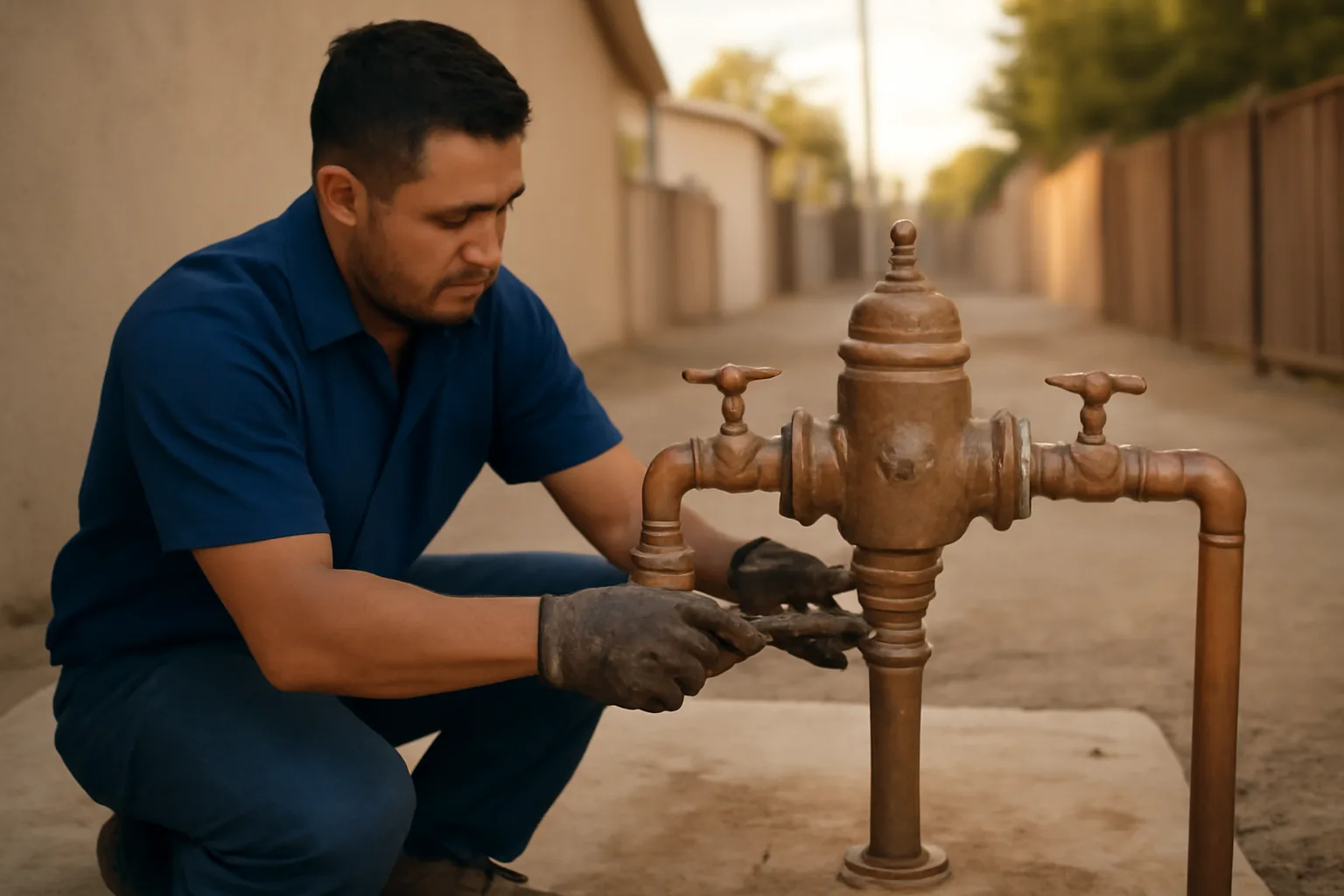
Most days you are on a site with a reduced pressure principle assembly, a double check, or a pressure vacuum breaker. You hook a differential pressure gauge to the test cocks, run a published procedure, and pass or fail the unit. Fail means the owner has to repair or replace it. You do not rewrite the plumbing code on the spot. You record numbers and leave a paper trail.
Public water systems sit under federal drinking water standards in 40 CFR Part 141. [2] States then run cross-connection control so those standards are not wrecked at a hose bib, a boiler feed, or an irrigation tap. The backflow tester is the field end of that file. If you like gauges, short site visits, and forms that have to be right, this work fits. If you want to design piping, you are in the wrong lane.
How do you start as a backflow tester?
You start by picking the jurisdiction that will accept your reports, then taking the course and exam that board names. There is no national backflow tester license. A school certificate does not automatically let you test in the next county.
Typical path: a tester course, a written exam, a hands-on exam on the common assemblies, then an application to a state agency or a local water purveyor. Texas is the clean example because the state itself licenses the tester. TCEQ issues the Backflow Prevention Assembly Tester license. [3] TCEQ occupational licenses are issued for a three-year period. [4] Confirm the current course list and the application with TCEQ. I would not buy a second "national" card until you know who files your first report.
If the work is in California, start with the water supplier and Title 17, not a forum thread. See how to start as a backflow tester in California and the California license paper. Washington is a Department of Health BAT path under WAC 246-290-490. [6] Florida puts the duty on the public water system in Rule 62-555.360, and the tester still has to be someone that system will accept. [7]
Do the course in the state where you will actually test. Reciprocity is messy. Then get on the list the purveyor uses. Until your name is on that list, you are a student with a gauge.
Is there a national backflow tester license?
No. The United States does not issue a national backflow tester license. Schools and groups sell certificates. Water purveyors and state boards decide whose reports they will file. Those are different things, and mixing them up wastes a winter of tuition.
Federal law sets drinking water standards for public systems. [2] Cross-connection control is how states and cities keep those standards from failing at a private connection. Oregon writes that duty into OAR 333-061-0070. [8] Virginia puts cross-connection control and backflow prevention in 12VAC5-590-610. [9] New York puts it in 10 NYCRR 5-1.31. [12] None of those rules create a single federal tester card.
What you can carry across a state line is training history, not a right to test. Some boards will look at ASSE 5110, AWWA, or a USC Foundation course and still make you sit their exam. Some will not look at it at all. I treat every new county as a new application. That is slower. It is also how you avoid a rejected report in July when the irrigation clocks are all due.
If a salesperson tells you one card covers "all 50 states," walk. Ask the water purveyor who they list, and ask the state board what statute they enforce. Those two answers are the whole game.
What training actually gets you on a list?
The training that counts is the course your accepting board names, plus a pass on the exam they recognize. Everything else is optional resume padding. I would take the named course first and ignore catalog add-ons until you have paid work.
Texas publishes approved BPAT training on the TCEQ license page and sets tester licensing in 30 TAC Chapter 30, Subchapter H. [3][10] Washington certifies the backflow assembly tester through the Department of Health, and WAC 246-290-490 requires the purveyor to use testers who meet that certification. [6] California's Title 17 duty sits on the water supplier, which then names the tester credentials it will take. [5]
Course length is a school and board fact. It moves. Do not freeze a number from a blog. Open the current board list. If the board says the school is approved, that school is the one I would pay. If the board is silent, call them before you send a check.
Hands-on time on an RP, a DC, and a PVB matters more than slide decks. You will test those three in the field until you dream in psid. Fire protection and specialty assemblies come later. Nobody needs a week of theory on devices you will not see until year three.
Do you need a plumbing license to test?
Sometimes. It depends on whether your state treats testing as a water-program credential, a plumbing task, or both. Confirm it with the board that covers the site. I will not pretend there is one answer.
Testing is often a separate card from installing or repairing. Repair without the right plumbing or mechanical license is how testers get into trouble. If the assembly fails, your job in many towns is to fail it in writing and stop. The repair person is someone else, unless you also hold that license.
Alabama, Arizona, and Alaska do not share a template. Read the state path before you print business cards. Start with how to start in Alabama, how to start in Arizona, and how to start in Alaska.
If you already hold a plumbing license, you still may need the tester credential. The plumbing card does not magically make your gauge legal. If you do not hold a plumbing license, you can still test in states that split the work, but you should not open the body of the assembly. Stay in your lane on day one. That is not timid. That is how you keep the credential.
What paper does a first-year tester file?
You file the test report the water purveyor specified, on their form or electronic portal, by their due date, with your credential number and gauge serial number. That report is the product. The customer copy is secondary.
Expect, at minimum: tester name and certification or license number, assembly location and serial, assembly type and size, line pressure, the recorded test values, pass or fail, date, and gauge identification. Many purveyors also want the owner's account number. If you skip a field, the clerk kicks it back and you have unpaid time in the truck.
Washington's rule is blunt about the purveyor's duty. WAC 246-290-490 states, "The purveyor shall protect the public water system from contamination due to cross-connections." [6] Your report is how they show that protection on a given service. California puts the program duty on the water supplier in Title 17. [5] Florida requires community water systems to have a cross-connection control program under Rule 62-555.360. [7]
Keep a copy of every report, the gauge calibration certificate, and your current card. Paper or PDF, both, if you can stand it. Hard drives fail. So do glove boxes.
If you want the ASSE 5110 and 5115 form set in one place, ASSEPath publishes a $149 one-time tester kit at /start. ASSEPath is an independent publisher, not a board and not a testing company. The board's form still wins if it conflicts.
How much does starting actually cost?
Nobody publishes a clean national total. Tuition is private. Application fees are board-posted and they change. Insurance quotes move with your state and whether you also repair. I will not invent a current fee. Confirm each line with the school, the board, and a licensed insurance agent.
The honest pile looks like this: tester course tuition, exam fees, state or local application, a field gauge kit, annual gauge calibration, liability insurance, truck stock (fittings, hoses, a canopy, boots), and whatever business registration your city wants. Course prices posted by schools sit in a wide band because the market is private. Treat any blog "average" as stale.
Texas application amounts belong on the TCEQ fee page, not in my paragraph. [3] California local listing fees belong with the water supplier. [5]
Waste of money in year one: extra certificates the local list does not name, branded polos, and scheduling software with a monthly bill while you have twelve customers. Spend on the gauge, the calibration, and insurance. Skip the rest until invoices are real.
| Place | Who you answer to | What you confirm before you pay |
|---|---|---|
| Texas | TCEQ BPAT license | Current course list, application, three-year term [3][4][10] |
| Washington | DOH BAT certification | WAC 246-290-490 and the BAT program page [6] |
| California | Water supplier under Title 17 | Local tester list and the credential they name [5] |
| Florida | Public water system CCC program | Rule 62-555.360 plus county practice [7] |
| Oregon | State CCC rule plus the supplier | OAR 333-061-0070 [8] |
| Virginia | Waterworks CCC rule | 12VAC5-590-610 [9] |
| New York | State Sanitary Code plus the supplier | 10 NYCRR 5-1.31 [12] |
What gauge kit should you buy in year one?
Buy a differential pressure gauge kit that your course and your purveyor will accept, then keep the calibration current. That is the whole equipment decision. Fancy extras can wait.
A working tester kit is a mid-range differential gauge, hoses, adapters for the common test cocks, a spare set of fittings, and a hard case that survives a truck bed. Needle kits and three-valve manifolds are normal. I would not buy the cheapest no-name gauge online. If the needle sticks, your report is fiction.
Used can be fine if a known shop calibrates it before you take a job. Ask for the certificate with the serial number that matches the gauge in your hand. If the seller cannot produce that, it is a paperweight.
Do not test with an out-of-date calibration. Purveyors will bounce the report. Some want calibration every year. Some want it more often. Confirm the interval with the list you are on, not with a manufacturer brochure.
Skip the $4,000 "complete shop" bundle until you have failed a few RPs and know which adapters you actually chew through. Year one is a gauge, hoses, and a notebook. Anything else is a gift to the vendor.
How do you get hired or on a water district list?
You get on the list the water purveyor publishes, or you work for a company already on it. Cold-calling property managers before you are list-eligible wastes both people's time.
After the card is in your wallet, ask the utility for the tester registration form. Some want a copy of your certification, gauge calibration, and insurance additional-insured language. Some want you in their portal. Do that paperwork the same week you pass the exam. Lists fill before irrigation season.
Municipal work, fire-line tests, and hospital campuses often want a W-9, a COI, and sometimes prevailing-wage paperwork. Small restaurants want you on Tuesday before the health inspector. Price the small jobs so the drive is covered. Price the campus jobs so the portal time is covered. They are not the same hour.
Colorado, California, and Arizona each have their own list culture. If that is your market, read how to start in Colorado and the Arizona license path before you print a service area the size of a time zone.
I would pick one utility and get boringly reliable. Ten on-time reports beat a hundred-mile radius and a voicemail full of angry clerks.
What happens when a test fails?
You fail it in writing, you tell the owner, and you follow the purveyor's repair clock. You do not "make it pass" with a friendly number. That is how testers lose the card.
A failed RP, DC, or PVB means the assembly did not meet the test criteria in the procedure you were taught. Common causes are debris, worn check springs, and shutoff valves that will not hold. Your report should show the values you got, not the values that would have been convenient.
The owner then has a deadline from the water supplier to repair or replace. That deadline is local. Confirm it. In many programs the tester who failed it is allowed to retest after a licensed repair person works. In some programs you cannot repair if you only hold the tester credential. Stay inside the license you have.
Retest fees are your business decision. I charge for the second trip. Free retests train customers to skip maintenance and use you as a warranty department.
If the owner refuses to repair, you still file the fail. The purveyor's enforcement is their problem. Yours is an accurate report.
How does recertification and gauge calibration work?
Your tester card expires on the board's cycle, and your gauge expires on the calibration cycle the purveyor named. Track both on a calendar. Missing either one stops your reports overnight.
Texas licenses in this program are issued for three years, which is a board-confirmable term, not a guess. [4] Other states use different clocks. I would set a reminder 90 days out. Exam seats fill.
Recertification may be an exam, continuing education, or both. Confirm the current rule. Do not trust a flyer from 2019. Gauge calibration is usually annual, done by a shop that can issue a certificate against a standard. Keep the paper with the serial number.
If you let the card lapse, you are not a tester until you are reinstated. Work done in the gap is a gift to a plaintiff's lawyer. File the renewal first. Then schedule the irrigation park.
What would I skip in the first year?
I would skip extra national certificates the local list does not name, skip monthly software until the calendar is full, and skip repairing assemblies unless the plumbing license is already in your pocket. I would also skip a giant service area.
Take the named course. Pass the exam. Register with the purveyor. Calibrate the gauge. Buy insurance. Test the devices you were taught. File clean reports. That is a first year.
State quirks are real. Use a state guide when the work is there, including backflow tester license in Alabama and backflow tester license in Alaska. Confirm fees, forms, and processing with the board. No article can promise approval or a timeline.
If you still want the form kit after that, it is at /start. The kit does not replace the board. Nothing does.
Frequently asked questions
What is a backflow tester?
A backflow tester is the person who field-tests backflow prevention assemblies and signs the report a water purveyor keeps. You record pass or fail values on RP, DC, and PVB assemblies so contaminated water cannot reverse into the potable supply. Installation and repair may need a separate plumbing license. Confirm the split with the board that covers the site.
How do you start as a backflow tester?
Pick the jurisdiction that will accept your reports. Take the course and exam that board names. Apply for the state license or local listing they use. Then register your gauge and insurance if they ask. There is no national license. Texas uses a TCEQ BPAT license. Other states use a water-board or purveyor list. Confirm current forms with that board.
Is there a national backflow tester license?
No. The EPA sets drinking water standards for public systems, and states run cross-connection control, but no federal tester card exists. Certificates from schools are not a right to test in every county. Ask the water purveyor who they list and the state board which statute they enforce. Those two answers control your first year.
Do I need a plumbing license to test backflow assemblies?
It depends on the state and on whether you will repair the assembly. Many programs split testing from installing. A tester card does not always let you open the body of the device. A plumbing license does not always let you file a test report. Confirm both with the board and the purveyor before you bid a repair.
How long is backflow tester school?
Course length is set by the school and by whatever the board will accept. It is not a frozen national number. Open the current approved-course list for your state and read the hours they post. I would not pay for a class that is missing from that list, even if the brochure looks serious.
Can I test in two states with one certificate?
Usually no, not without a second application. Some boards will look at ASSE 5110, AWWA, or similar training and still make you sit their exam. Reciprocity, if it exists, is written in that state's rule, not in the school's marketing. Treat each state as a new paper path and confirm it before you drive across the line.
What assemblies does a new backflow tester actually test?
Reduced pressure principle assemblies, double checks, and pressure vacuum breakers make up most first-year stops. Fire-line and specialty assemblies show up once you are on larger lists. Learn the published procedure for those three until you can run it without looking at the card. That covers the work that pays the truck.
Who pays for the annual backflow test?
The property owner or the customer of record pays. The water purveyor requires the test. You invoice the owner, not the city, unless you are on a municipal contract. Get the billing name before you hook up hoses. Property-manager accounts go stale, and you should not eat that.
What happens when a backflow assembly fails the test?
You file a fail with the recorded values, notify the owner, and follow the purveyor's repair deadline. Do not invent a pass. Repair may require a plumbing license you do not hold. Retest after the repair, on a second trip you should charge for. The purveyor handles enforcement if the owner stalls.
Do I need gauge calibration records as a backflow tester?
Yes. Purveyors want the gauge serial number and a current calibration certificate with many reports. An expired sticker is enough for a clerk to reject the filing. Calibrate on the interval the list names, keep the paper, and match the serial to the gauge in the case. No certificate, no test.
How often does a backflow tester credential expire?
It follows the issuing board, not a national calendar. TCEQ occupational licenses are issued for three years. Other states use different terms and may want an exam or continuing education. Confirm the date on your card and set a reminder 90 days out. Work done after a lapse is a problem you do not need.
Should I form an LLC before I have backflow testing work?
Only if your accountant or a lawyer in that state says the paper is worth it. An LLC does not put you on a water district list. Insurance and the tester credential matter more in month one. I would get on a list and invoice a few jobs before I paid for an entity I might not use.
What is ASSE 5110 for a backflow tester?
ASSE 5110 is a personnel qualification many schools teach to for backflow prevention assembly testers. It is not a federal license. Some boards accept it as training evidence. Some still require their own exam or a local listing. Ask the purveyor which credential number they want on the report before you pay for a second card.
Are backflow test reports public records?
Often the water purveyor holds them as part of the cross-connection file. Whether a neighbor can pull yours is a local public-records question, not a tester question. Write every report as if a lawyer will read it. Values, serials, dates, and your credential number should match the assembly on the wall.
Sources
- U.S. EPA, Cross-Connection Control Manual (EPA 816-R-03-002): Defines backflow as the undesirable reversal of flow of water or mixtures of water and other liquids, gases, or other substances into the distribution pipes of the potable supply of water from any source or sources.
- eCFR, 40 CFR Part 141 National Primary Drinking Water Regulations: Federal National Primary Drinking Water Regulations that public water systems must meet, which is the quality baseline states protect with cross-connection control.
- California Code of Regulations, 17 CCR 7604: Requires the water supplier to protect the public water supply from contamination by implementing a cross-connection control program.
- Washington Administrative Code 246-290-490: Requires the purveyor to protect the public water system from contamination due to cross-connections and sets tester-related duties in the cross-connection control rule.
- Florida Administrative Code Rule 62-555.360: Requires community water systems to have a cross-connection control program.
- Oregon Administrative Rule 333-061-0070: Oregon drinking-water rule on cross connection control requirements for public water systems.
- Virginia Administrative Code 12VAC5-590-610: Virginia waterworks regulation on cross-connection control and backflow prevention.
- Texas Administrative Code, 30 TAC Chapter 30 Subchapter H: Texas sets Backflow Prevention Assembly Tester licensing in 30 TAC Chapter 30, Subchapter H.
- New York Codes, Rules and Regulations, 10 NYCRR 5-1.31: New York State Sanitary Code section on cross-connection control for public water systems.